

Pasquale J. Cuomo has spent more than five decades behind the camera, yet his approach to photography still carries the curiosity of someone discovering the medium for the first time. What began as a teenage fascination with cameras slowly became a lifelong practice rooted in observation, patience, and technical discipline. Cuomo first picked up a camera as a young man and never really put it down. Across changing eras of photography—from darkrooms and film stock to digital sensors, smartphones, and now AI-assisted imagery—he continued working steadily, adapting without losing sight of what first drew him to photography: the act of seeing.
Over the years, Cuomo moved through many areas of professional photography without confining himself to a single style or specialty. His career included wedding photography, fashion shoots, commercial assignments, architectural imagery, legal documentation, and public relations work. By the mid-1980s, he had developed a fully equipped studio and laboratory operation, giving him complete control over the photographic process from exposure to print. Clients valued his reliability and precision, but also his ability to notice details others overlooked. Cuomo approached photography with restraint and concentration, preferring to let the subject carry the weight of the image rather than forcing attention onto himself as the photographer.
That steady approach continues to shape his work today. While many photographers chase trends or heavily manipulated imagery, Cuomo remains grounded in composition, light, structure, and timing. Recently, he has returned to film photography, reconnecting with the slower and more deliberate process that first formed his understanding of the medium. For Cuomo, photography is less about novelty and more about sustained attention. His images reflect years of practice, technical knowledge, and an ongoing interest in how visual forms communicate through space, texture, and atmosphere.
Two photographs taken at the National Museum of the United States Air Force in Dayton, Ohio, offer a clear example of Cuomo’s enduring interests. The images focus on military aircraft, but they are not simply records of machines or historical artifacts. Instead, they examine the formal qualities of aircraft design while using photography to explore shape, contrast, scale, and composition.
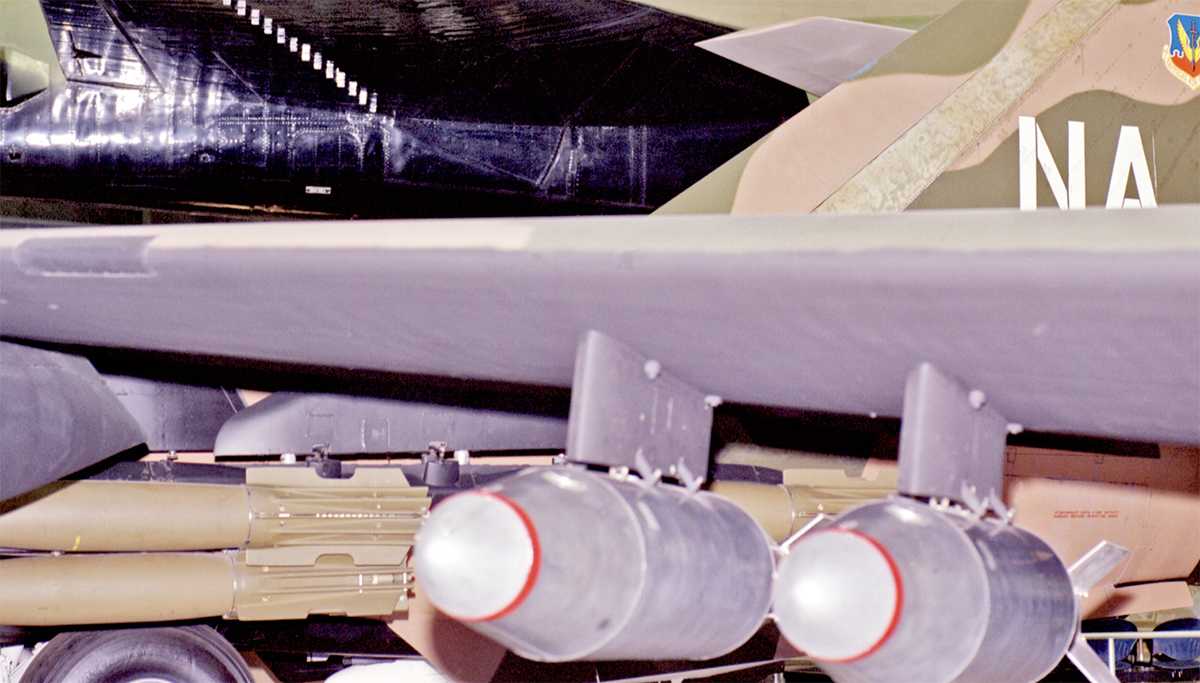
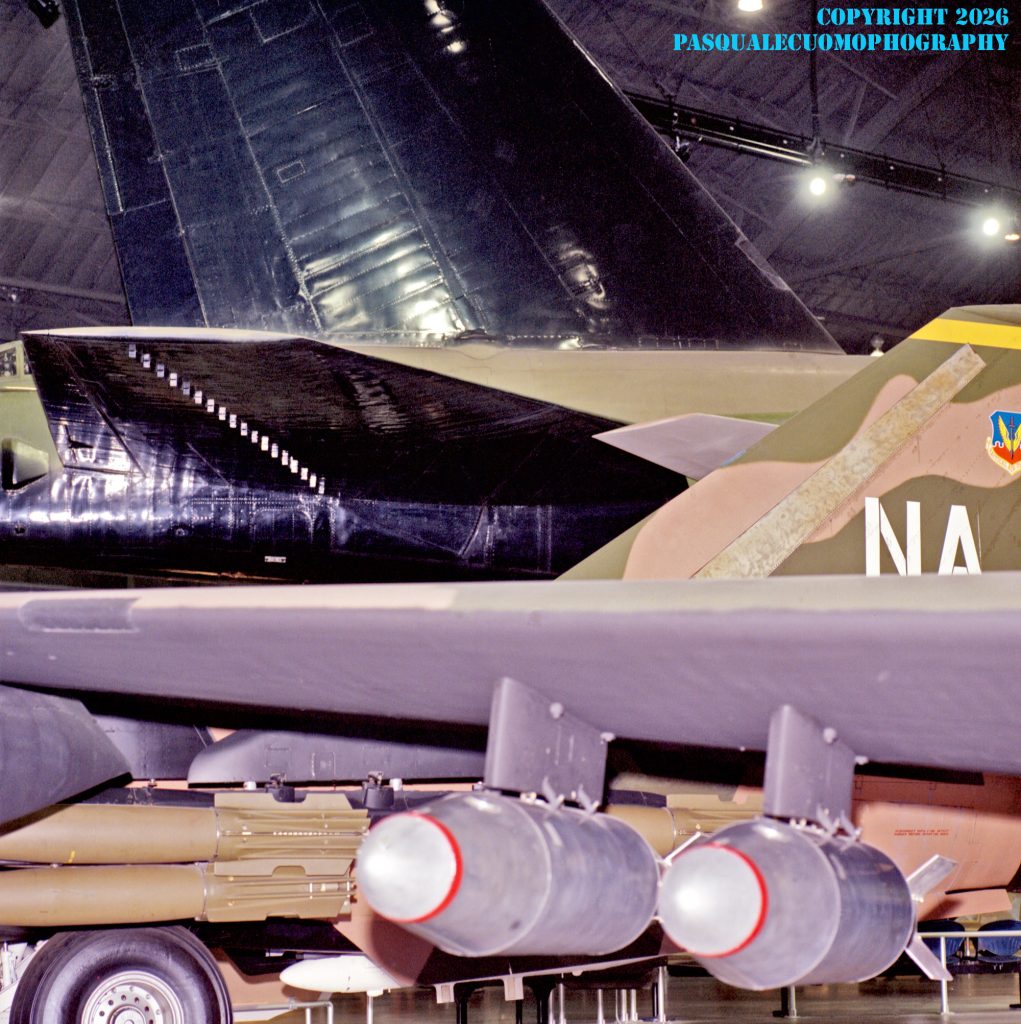
In the first photograph, Cuomo isolates the sharp angular surfaces of a stealth aircraft, allowing the dark geometry of the plane to dominate the frame. The composition compresses the image into intersecting diagonals, where wings, missile forms, and structural lines overlap one another. Rather than presenting the aircraft in full, Cuomo fragments the machine into abstract visual components. The glossy black surface reflects surrounding light, creating subtle tonal shifts across the body of the aircraft. These reflections soften the severe geometry just enough to give the image movement and atmosphere.
The photograph also demonstrates Cuomo’s sensitivity to balance. Large dark surfaces occupy much of the frame, yet the image never feels visually heavy. The missiles in the foreground introduce rhythm and repetition, while the muted camouflage tones create contrast against the deep black forms above them. The museum setting remains visible but secondary. Cuomo uses the environment not as a distraction, but as a framework that emphasizes the scale and physical presence of the aircraft itself.
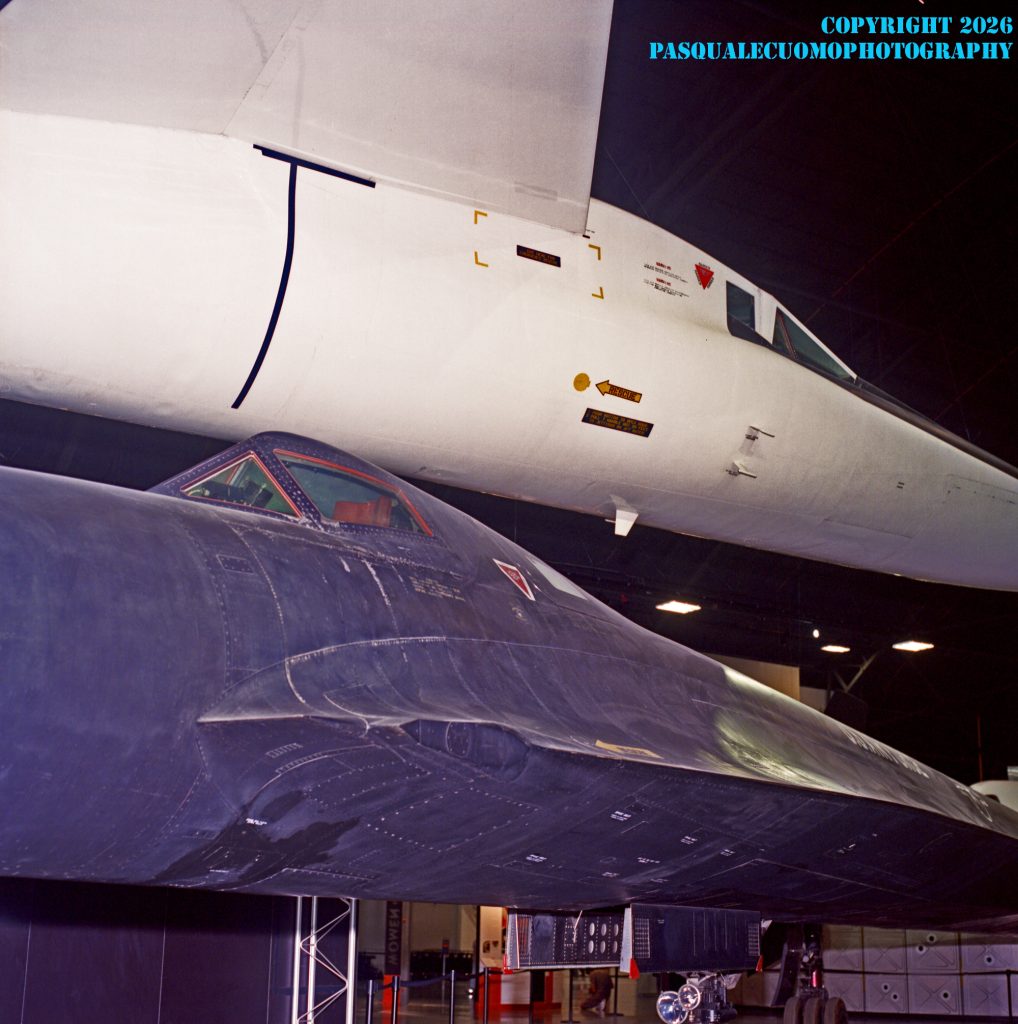
In the second photograph, Cuomo shifts attention toward the elongated contours of two legendary aircraft displayed together. The composition layers one aircraft above another, producing a visual dialogue between curves and aerodynamic precision. The upper white aircraft stretches across the frame with clean minimal surfaces, while the darker aircraft below introduces density and shadow. Together they create a striking contrast between light and dark, smoothness and weight.
What makes the image particularly engaging is Cuomo’s understanding of perspective. The aircraft appear monumental, almost sculptural, because of the low viewing angle and tightly controlled framing. Instead of documenting the museum display in a straightforward manner, Cuomo transforms the aircraft into abstract forms defined by line, proportion, and surface texture. The cockpit windows, markings, and subtle reflections become compositional accents rather than informational details.
There is also an underlying sense of admiration in these works. Cuomo’s interest in military aircraft design is evident, but his photographs avoid sentimentality or spectacle. He does not dramatize the planes through excessive editing or theatrical lighting. Instead, he allows the engineering itself to carry visual power. The aircraft become studies in human design and technological ambition, viewed through the disciplined eye of a photographer deeply aware of composition.
These images also reflect Cuomo’s long experience with film photography. The tonal handling, attention to exposure, and measured compositions reveal a photographer accustomed to slowing down and carefully constructing an image before releasing the shutter. Even within a museum environment filled with visual distractions, Cuomo isolates moments of clarity and order.
After more than fifty years of photographing the world in its many forms, Pasquale Cuomo continues to approach photography with patience and attentiveness. His work at the National Air Force Museum demonstrates how technical subjects can become thoughtful visual studies when approached with experience, curiosity, and restraint. The photographs are not simply about aircraft. They are about structure, observation, and the enduring act of looking carefully.
