

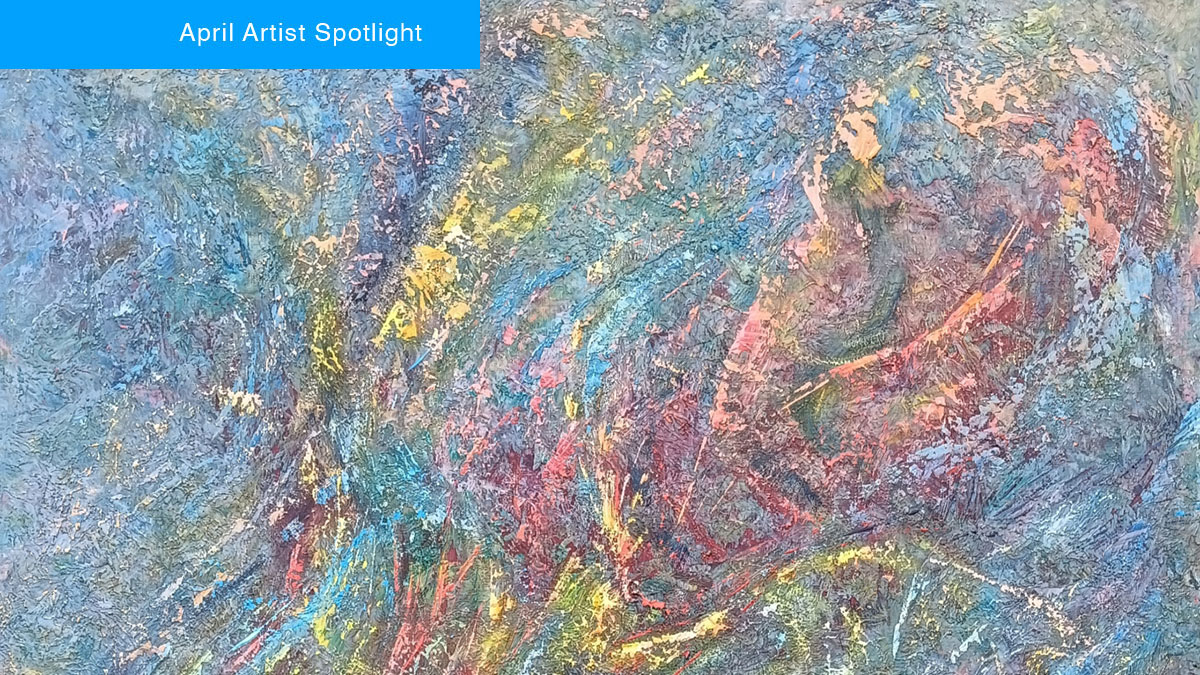
David John Hilditch, born in Wolverhampton in 1951, has shaped a practice that sits between painting and philosophical thought. His work avoids fixed meaning, instead opening a space for reflection on identity, perception, and experience. With a foundation that blends visual inquiry with intellectual exploration, Hilditch treats the canvas as something alive. Paint is not simply applied—it moves, responds, and continues to transform across the surface. His compositions feel removed from linear time, without a clear start or finish. What emerges is a visual field where perception is constantly shifting. Rather than standing apart from the work, the viewer is drawn into it, navigating a space where color, gesture, and form act as active forces that continually reshape the image.
The Work
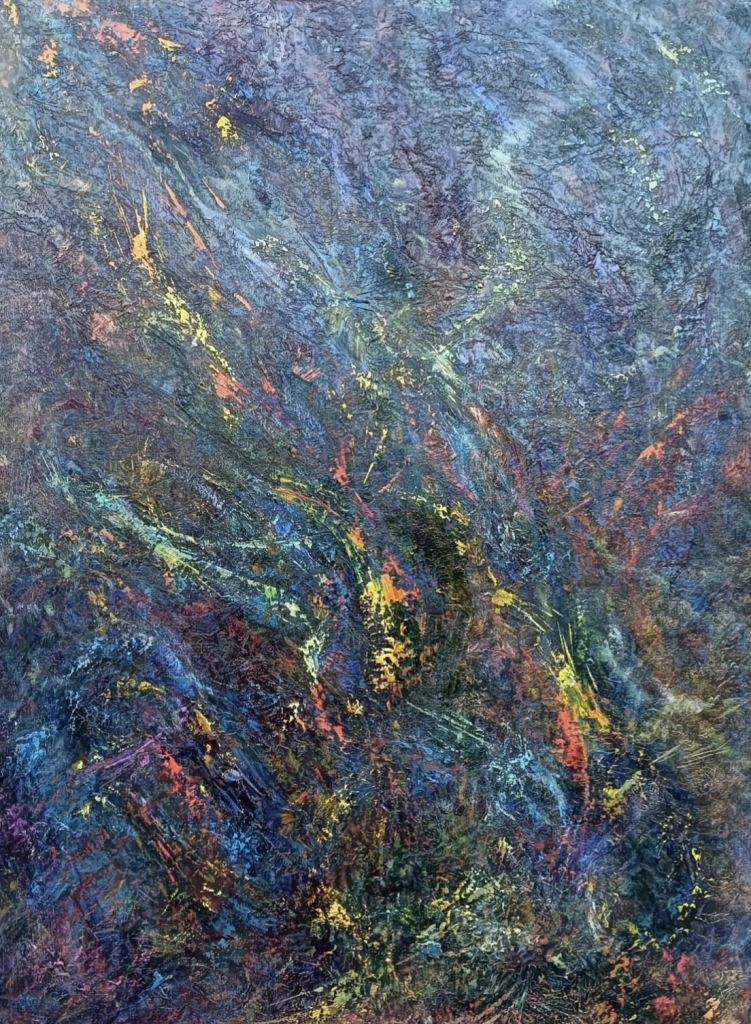
In Cascade 3 and Cascade 9, both oil on canvas at 3 by 4 feet, Hilditch’s approach becomes evident. These works move away from traditional representation. There is no fixed subject holding the composition together. Instead, each painting unfolds as a shifting field, where energy gathers, disperses, and reorganizes through layers of movement.
In Cascade 3, the surface feels dense and charged with activity. Deep blues and cooler tones create a foundation, interrupted by bursts of yellow, red, and green that cut through the composition in irregular paths. The paint appears to push outward and upward, as though driven from within. Toward the lower portion, darker tones cluster tightly before giving way to lighter, more dispersed marks above. This transition creates a vertical flow, guiding the viewer’s eye upward through the painting.
A key aspect of the work is the balance between control and unpredictability. The marks carry a sense of immediacy—splashes, streaks, and incisions that feel instinctive—yet they remain contained within a structure that holds the composition together. Lines intersect and overlap without collapsing into confusion. Color appears at measured points, energizing the surface without overwhelming it. The result is a tension between restraint and release, where the painting exists between order and disruption.
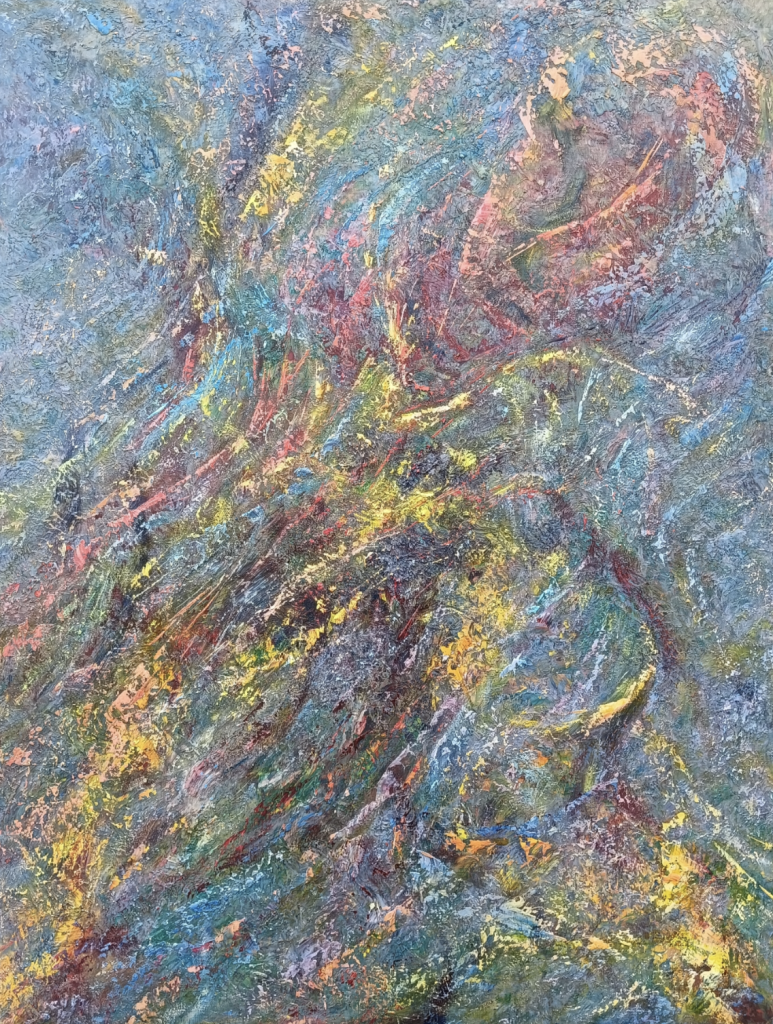
Cascade 9 introduces a shift in atmosphere while maintaining a sense of movement. The palette softens, with more subdued blues and lighter underlying tones. Bright accents—yellows, reds, and hints of green—remain present but feel more integrated into the surface rather than sharply contrasting. Movement expands across the canvas, spreading outward as much as it rises, creating a broader and more open composition.
Here, the paint appears to flow rather than erupt. Instead of concentrated bursts, sweeping gestures and layered textures suggest a gradual build-up over time. The surface holds a sense of accumulation, as if each mark has settled while still retaining traces of its original motion. This introduces a different kind of depth—less about spatial illusion and more about duration. The painting feels as though it has developed in stages, with each layer interacting with those beneath it.
Texture plays a central role in both works. The surfaces are built up, scraped back, and reworked, giving them a strong physical presence. Paint operates as a material rather than a tool for illusion, holding evidence of each action and adjustment. Light interacts unevenly across these textured areas, activating the surface as the viewer shifts position.
A quiet rhythm connects the two paintings. Despite their differences, both rely on repetition and variation. Certain gestures return—angled lines, clustered marks, layered passages—but never in the same way. Each instance shifts slightly, creating a visual language that continues to develop within the work. This approach reflects Hilditch’s broader concerns, where identity and perception remain fluid rather than fixed.
These paintings resist a single, definitive interpretation. They do not settle into one reading. Hints of landscape, atmosphere, or pure abstraction may emerge, but none fully define the work. Instead, the paintings remain open, allowing multiple interpretations to exist at once.
In this way, Cascade 3 and Cascade 9 function less as static images and more as experiences. They invite the viewer to engage directly—to follow the movement of paint, to trace connections between color and gesture, and to stay within that process without seeking resolution. Hilditch does not provide conclusions. His work creates a space where perception itself becomes the focus, continually shifting and never fully settled.
