

Born in 1949 and raised in California’s San Francisco Bay Area, Deborah K. Tash is a visual artist and poet whose creative practice explores cultural identity, spirituality, and the natural world. Her artistic perspective is influenced by her mother’s Mexican ancestry and her father’s Celtic heritage. Identifying as Mestiza, Tash embraces the intersection of these traditions, drawing inspiration from their histories, mythologies, and relationships with nature.
Painting and poetry serve as complementary forms of expression, allowing her to explore experiences beyond conventional language. Her compositions examine the relationship between visible reality and the unseen, inviting reflection on memory, transformation, and the mysteries of existence. Through atmospheric color, symbolic imagery, and thoughtful compositions, Tash creates visual environments where personal history meets universal questions. Her work encourages viewers to contemplate the spiritual dimensions of everyday life and the enduring connections between humanity, nature, and the unknown.
Cloudscape Design Series / The Eye of God
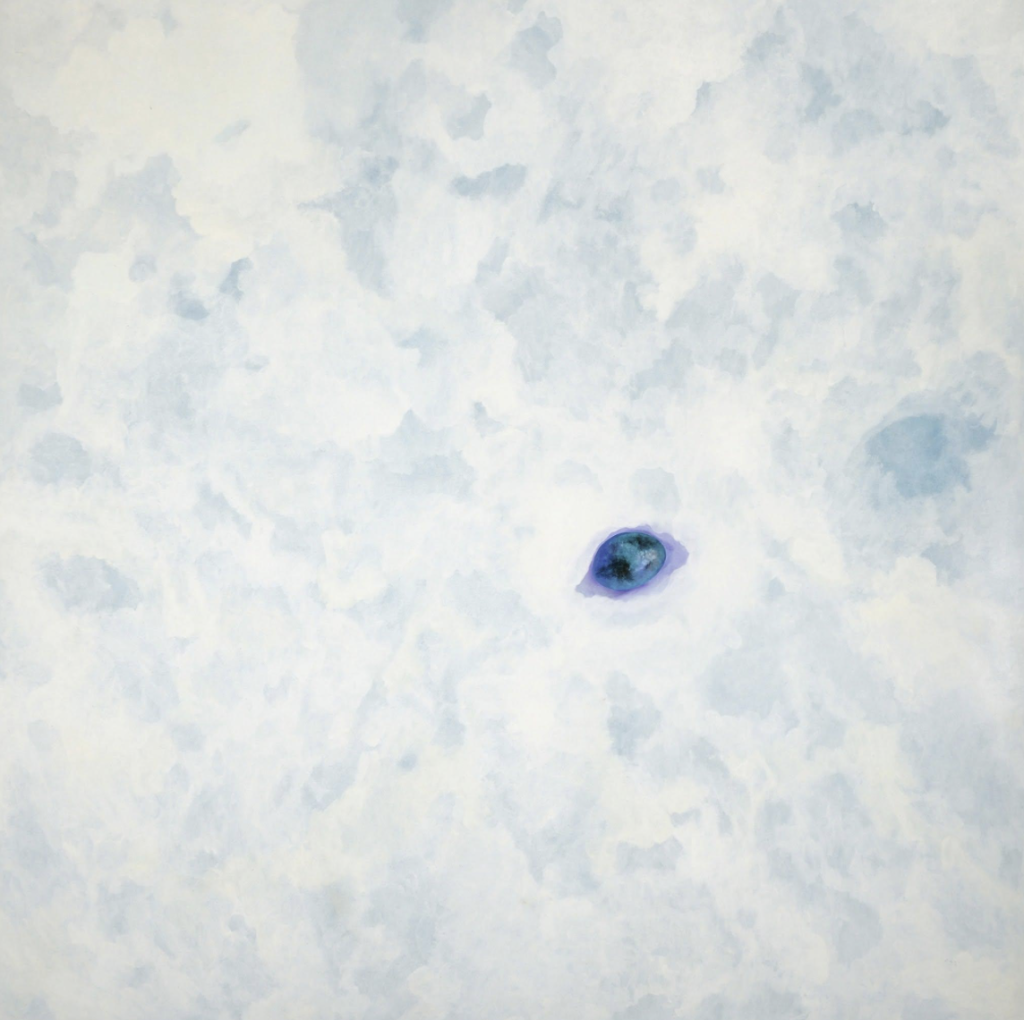
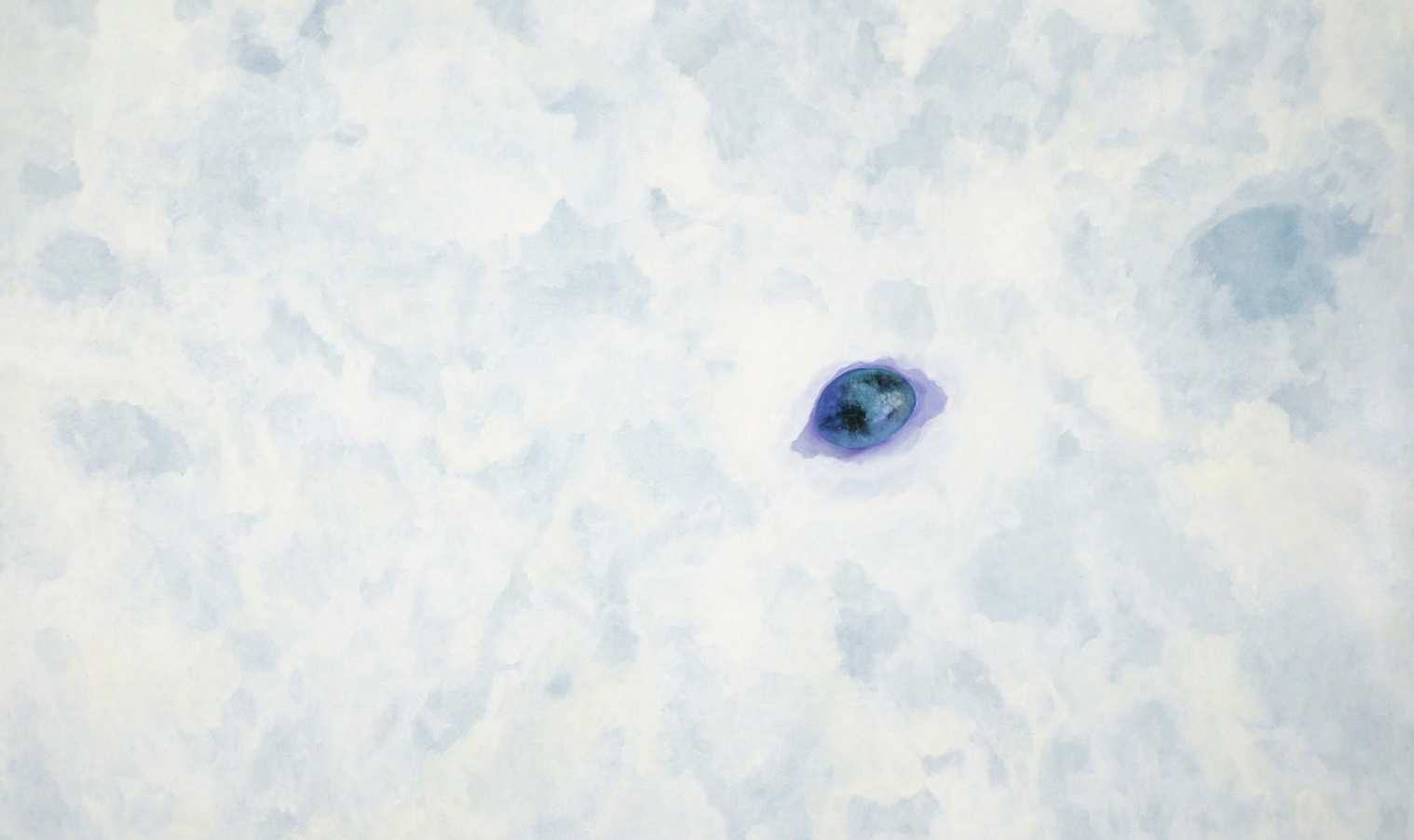
In Cloudscape Design Series / The Eye of God, Deborah K. Tash explores the relationship between atmospheric space, spiritual awareness, and the human desire to understand what exists beyond immediate perception. The painting presents an expansive field of delicate whites and pale blues, interrupted by a small, concentrated form resembling an eye. Through this restrained composition, Tash transforms a familiar natural phenomenon into a meditation on observation, presence, and the mysteries concealed within the visible world.
The painting is dominated by a luminous cloudlike environment. Layers of white, icy blue, and muted gray create a softly textured surface suggesting drifting clouds, mist, or an endless celestial expanse. Rather than depicting a conventional landscape with a recognizable horizon, Tash allows the entire composition to become an atmospheric space. There is no clear distinction between foreground and background, giving the impression of looking into an environment without measurable boundaries.
This absence of fixed spatial references contributes to the painting’s contemplative character. The viewer encounters a surface that feels simultaneously expansive and intimate, as though the sky has been brought close enough to reveal its smallest variations. Gentle transitions between colors suggest movement, while the overall composition maintains an atmosphere of stillness.
Near the center-right of the painting, a small oval form emerges from the surrounding pale surface. Its deep turquoise, blue, and dark green tones contrast with the subdued colors of the cloudscape. Encircled by a violet-blue border, the form resembles an eye suspended within the atmosphere. Although modest in scale, it becomes the primary focal point, drawing attention through its concentrated color and unusual placement.
The title, The Eye of God, introduces a spiritual dimension to this visual arrangement. Across different religious and cultural traditions, the eye has been associated with awareness, protection, divine observation, and consciousness beyond ordinary human understanding. In Tash’s painting, the eye may symbolize spiritual perception, suggesting that something unseen exists within the seemingly empty spaces of nature.
Yet the composition does not impose a single interpretation. The central form might also evoke a celestial body, an opening in the clouds, or an organic structure observed from an unfamiliar perspective. Its ambiguity allows the painting to move between physical and metaphysical worlds. What initially appears to be an atmospheric study gradually becomes an invitation to consider the relationship between seeing and knowing.
Color plays an essential role in establishing this relationship. The pale blue and white background creates a sense of openness and tranquility, while the darker central image introduces depth and visual intensity. The purple surrounding the eye provides a subtle transition between these contrasting elements. This limited palette gives the composition coherence while allowing small variations in tone to carry expressive meaning.
Equally important is Tash’s treatment of negative space. Much of the painting remains visually quiet, with the eye occupying only a small portion of the surface. This difference in scale emphasizes the vastness of the surrounding atmosphere and encourages viewers to consider the relationship between the individual and the infinite. The central image appears both isolated and connected to its environment, suggesting that even the smallest presence may hold meaning within a larger universe.
The cloudscape also reflects Tash’s interest in nature as a source of spiritual reflection. Clouds constantly change, forming temporary shapes before dissolving into new arrangements. Their impermanence offers a visual metaphor for memory, transformation, and the passage of time.
There is also a poetic quality to the composition. Like a short poem, the painting communicates through suggestion rather than explanation. Its meaning develops through the interaction of a few carefully arranged elements: an atmospheric field, a solitary eye, and the surrounding silence.
Ultimately, Cloudscape Design Series / The Eye of God examines how a minimal visual encounter can inspire deeper contemplation. Through atmospheric texture, symbolic imagery, and carefully balanced color, Deborah K. Tash creates a painting connecting the natural world with questions of consciousness and spiritual presence. The work invites viewers to look beyond the surface of the sky and consider the mysteries that remain outside ordinary perception.
