

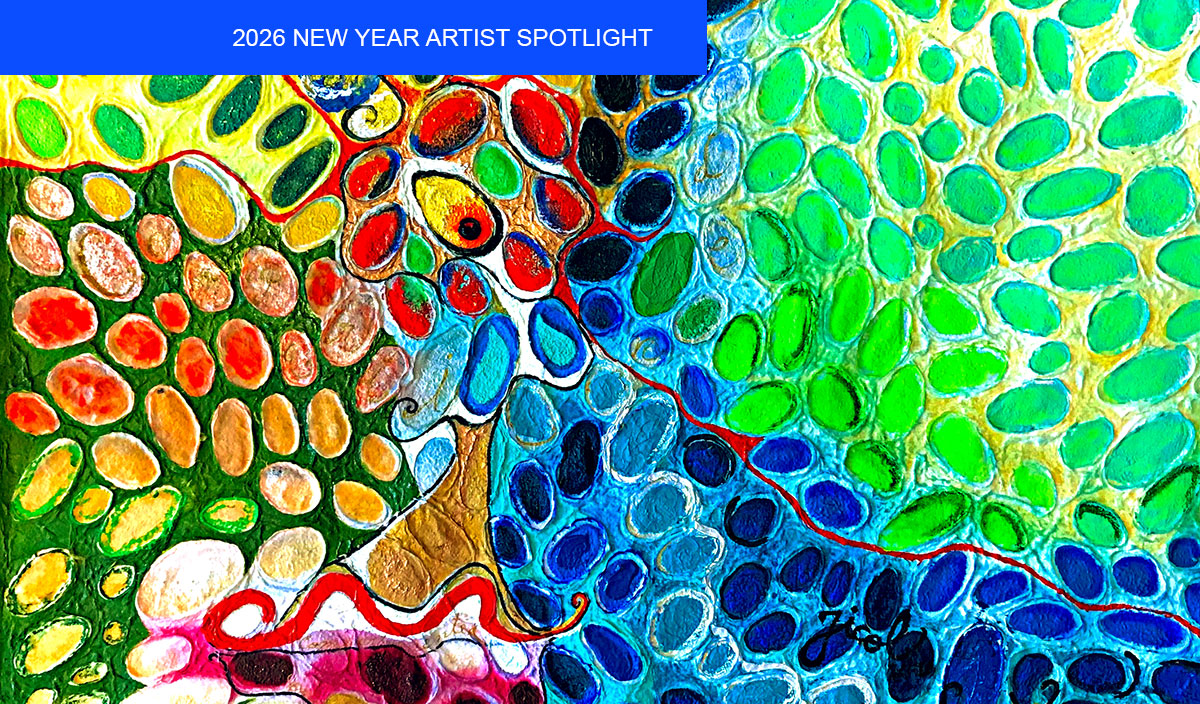
Alexandra Jicol’s practice grows out of a dialogue between inner experience and the outside world, between what is remembered and what is happening now. She spent her early life in Bucharest in a period marked by social constraint and pressure. Her surroundings offered sharp contrasts: the quiet freedom of natural landscapes alongside the structure and watchfulness of city life. Those differences left a quiet imprint. They appear in paintings where calm and tension live side by side. Open, breathable areas meet compact, denser forms. Soft hues exist next to subtle disquiet.
For Jicol, art begins with attention. She treats painting as a way to register experience and translate it into color, mark, and rhythm. She is not chasing spectacle; she leans toward introspection. Many of her works feel like visual notes or diary fragments where reflection, emotion, and release share the surface. The pieces feel personal, yet they are not sealed off. They leave space for viewers to step in and form their own readings from the layers she constructs.
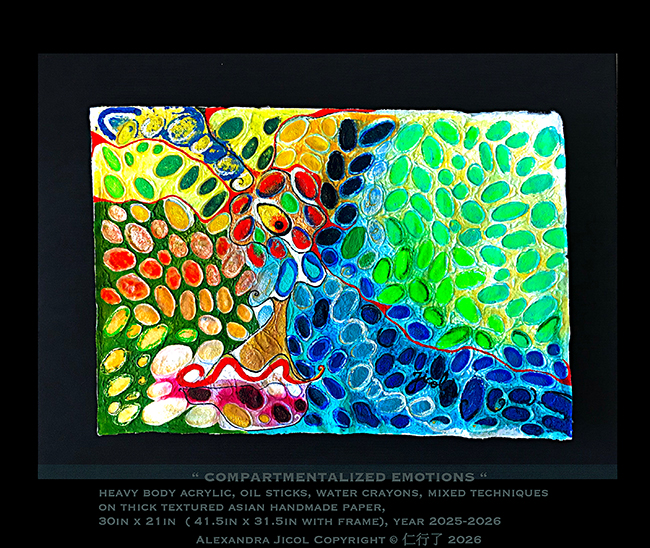
Her painting “Compartmentalized Emotions” (2025–2026) shows where her focus currently rests. Working with heavy body acrylic, oil sticks, water crayons, and mixed techniques on thick Asian handmade paper, she creates a surface that keeps evidence of each decision. The texture is visible. There is no attempt to hide revisions. Overlapping marks and meeting colors reveal the painting’s timeline.
The title refers to a familiar coping mechanism—dividing feelings into sections to keep moving through daily life. Jicol converts that idea into form. Areas of color act like partitions. Some seem closed off, others split or interrupted. Bits of language lie under layers of pigment, partly concealed. They resemble thoughts set aside but never fully gone.
Fine red strands travel through the composition like veins or threads. They suggest emotional traces that remain. Yet the work is not anchored only in weight. Jicol speaks of hope, passion, and generosity as lasting elements. That presence shows in lighter zones where color opens and lifts. The painting does not aim to resolve emotion. It allows feelings to coexist, overlap, and remain incomplete.
Her choice to sell only originals connects naturally here. Each piece stands as a singular moment that cannot be replicated. Even the note that colors shift under different lighting reinforces the idea that perception is fluid. What we see changes with context, just as emotional states do.
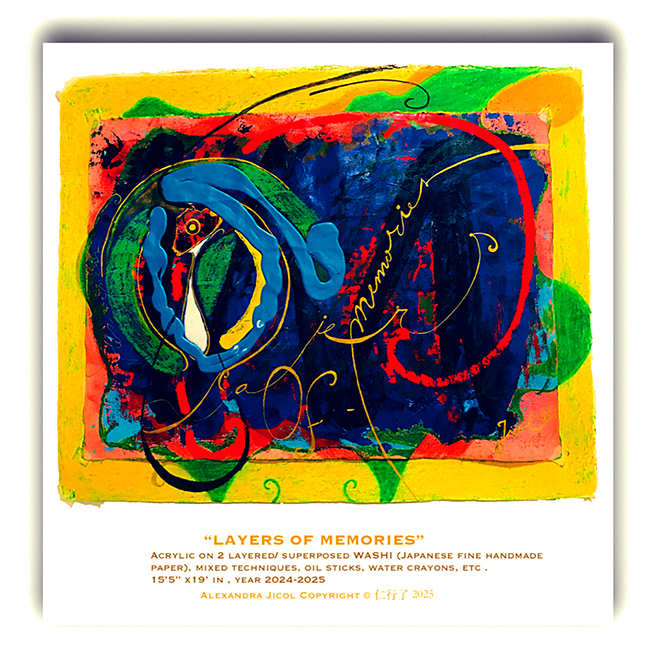
While “Compartmentalized Emotions” centers on dividing and containing, “Layers Of Memories” (2024–2025) considers accumulation. Made on two sheets of Japanese handmade paper layered together and worked with acrylic, oil sticks, and water crayons, the painting reflects how memory builds. Experiences are not erased; they are covered, adjusted, or reframed.
Jicol describes memories spanning grief, tenderness, trust, and longing. This range appears in the movement between saturated and open areas. Some passages feel dense with pigment, others lighter and more spacious. The dual sheets of paper quietly echo the idea of support—one layer holding another, much like the past supports the present.
There is also the feeling of sudden recall. Memory can surface unexpectedly. A tone, a texture, or a faint word can bring it forward. Jicol keeps her work abstract rather than narrative. She does not assign fixed meanings. This openness allows viewers to bring their own recollections. The painting becomes a shared reflective space instead of a single storyline.
Across both paintings, the act of making remains central. Mixed media supports change. Marks can be covered and later revealed at the edges. This reflects how people revisit and reinterpret their histories. Handmade paper introduces fragility and tactility. Pigment absorbs differently, creating depth without a glossy finish.
Jicol often describes herself as someone who observes carefully—watching, listening, and taking in details without quick conclusions. That mindset shapes the work. Her paintings do not instruct. They present emotional landscapes and allow quiet navigation.
Her use of color also shows moderation. Even when tones intensify, they do not overwhelm. They settle into place. This encourages slow looking. A viewer can spend time noticing shifts rather than receiving everything at once.
At the heart of Jicol’s practice is a straightforward but demanding idea: meeting the inner world with honesty. Emotions may be ordered or tangled. Memories may comfort or weigh. Connection and distance can exist at the same time. Her paintings do not promise neat resolution. They offer recognition. In that space of recognition, viewers may encounter parts of their own experiences, resting gently within the layers.
