

Jane Gottlieb’s practice has been shaped by a sustained curiosity about color, motion, and visual intensity. Born in Los Angeles and now based in Santa Barbara, she started out in painting before moving into photography, where she began exploring structure, rhythm, and light from a different angle. More than thirty years ago, she introduced a shift that still defines her work: hand-painting individual Cibachrome prints. Through this method, photographs are no longer final images but become physical objects open to change. She treats the photographic surface as something active, something to work into. Color is absorbed into the image rather than simply applied. What emerges is work that sits between painting and photography, holding both the immediacy of the camera and the presence of touch.
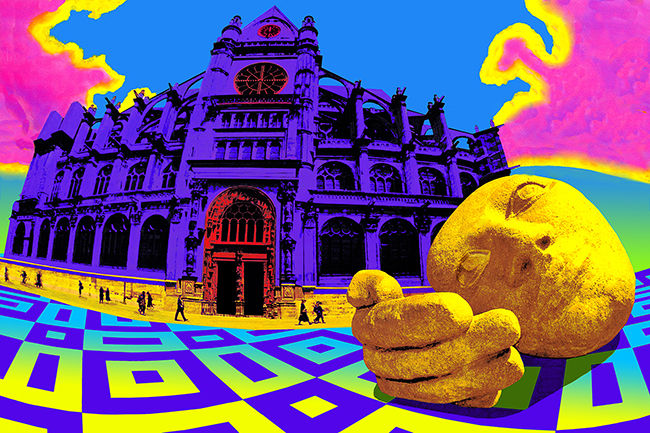
Her work avoids settling into a single category. Photography becomes a point of departure rather than a conclusion. In Brancusi Head, Paris, this approach is immediately visible. The architectural form remains recognizable, but it is pushed into a different register through bold, heightened color. What might have read as a straightforward depiction of place instead shifts into something interpretive, almost staged in its transformation.
Color takes on a dual role, both building and unsettling the image. Deep purples, dense blues, and sharp yellows compress and stretch the space at the same time. Perspective becomes unstable. The structure is still there, but it no longer holds as a fixed environment. Instead, it begins to feel internal, as though shaped by perception rather than observation. The sculptural head in the foreground adds another layer, introducing a presence that feels slightly off-center, both playful and disorienting.
There is a constant pull between recognition and change. The architecture offers a point of reference, while the color disrupts it. Gottlieb creates movement within a still image, guiding the eye through contrast and intensity rather than conventional composition. The gaze doesn’t settle. It continues to shift across the surface.
This effect is inseparable from her process. By painting directly onto Cibachrome prints, she engages physically with the image. There is no reliance on digital tools. Each mark remains visible, reinforcing the individuality of the work. The photograph serves as a base, but the final piece carries the accumulation of time and gesture. It holds both the original capture and the artist’s continued involvement.
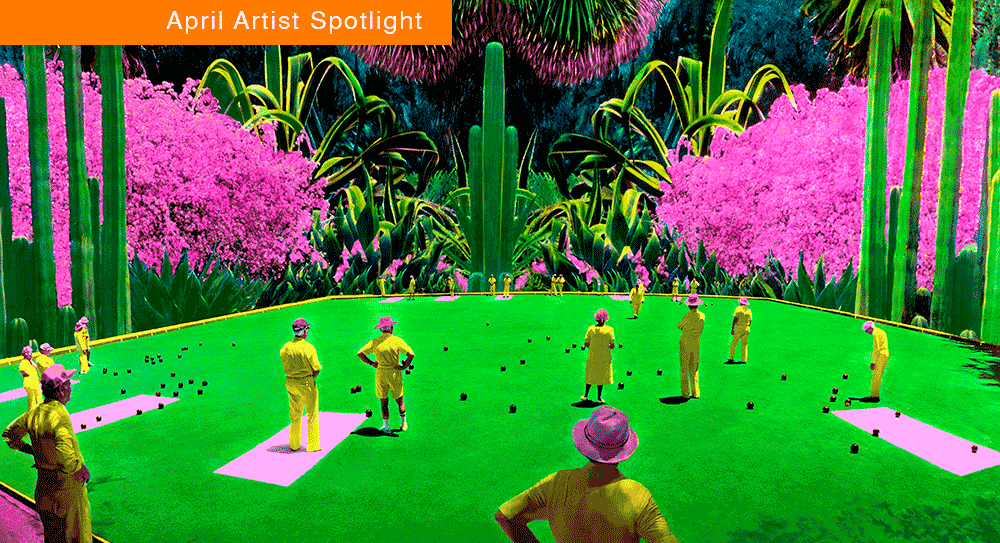
In Lawnbowler’s Series: Life, the focus moves from architecture to human activity, while maintaining the same sense of transformation. The scene presents figures playing lawn bowling, but the environment resists natural behavior. The landscape becomes intensified, almost unreal. Bright greens dominate the ground, while surrounding foliage shifts into saturated pinks and layered textures.
The background plays a central role here. Gottlieb has described adjusting it to evoke different emotional tones, and that shift is evident. The figures remain relatively stable, but the environment changes around them. The setting becomes active, shaping the experience rather than simply framing it.
The figures themselves are simplified, dressed in similar tones that allow them to blend into the scene while still holding their place. Their spacing creates a quiet rhythm. They are connected through the shared activity, yet each figure exists within its own space, suggesting both proximity and separation.
Color once again drives the work. It does not aim to describe reality but to construct an alternate version of it. The heightened palette introduces a sense of altered perception, as if the scene is being felt rather than observed. Gottlieb shifts the focus away from representation and toward experience.
A subtle narrative runs through the piece. The title Life suggests that the image extends beyond the activity itself. It becomes a reflection on participation and distance. The figures engage in a structured game, while the surrounding environment feels open and unpredictable. This contrast creates a quiet tension, echoing the balance between control and uncertainty.
Across both works, Gottlieb follows a consistent approach. She begins with recognizable imagery but moves beyond it through intervention. The photographic base anchors the work, while the hand-painted surface introduces variation and presence.
Her practice exists between mediums. It is not fully painting and not strictly photography. It is a hybrid form where color leads and structure adjusts. Each work asks for a different kind of attention, one that moves beyond identification and into perception.
