

Some artists start with what they see. Others begin with what they feel. Rebecca Navajas clearly works from the latter. Her paintings are not concerned with exactness or faithful representation. They emerge from emotion first, with form and image following behind. Color is not applied for visual appeal alone. It carries meaning and pressure. Gesture is loose, responsive, sometimes unpredictable. It shifts, reacts, and resists control. Nothing in her work feels settled. Each piece holds a sense of motion, as if it continues to change even after it has been completed.
For Navajas, identity and lived experience are not fixed ideas. They exist in layers, often overlapping and unresolved. Her work suggests that strength can sit beside fragility without contradiction. Vulnerability is not hidden or softened. It is allowed to exist openly. There is a quiet steadiness in her paintings. They do not try to overwhelm, but they stay with you. What she creates is not a depiction of the external world, but a reflection of what it feels like to move through it.
This way of working becomes more apparent when looking closely at individual pieces, where personal meaning is embedded beneath the surface.
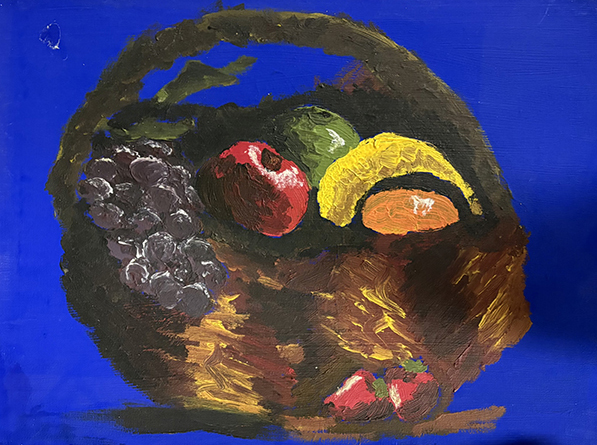
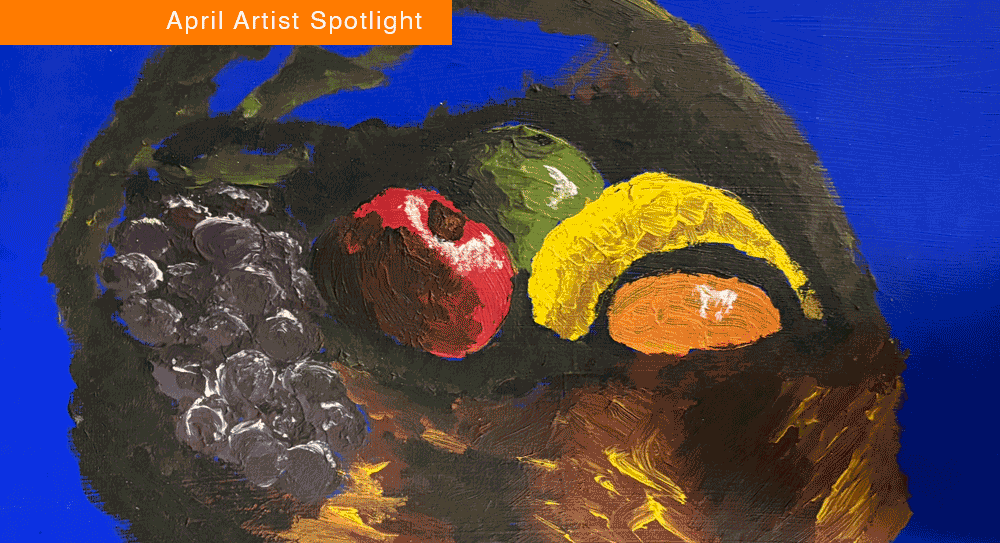
“Still life – still love” at first seems rooted in tradition. On the front, a basket of fruit is arranged with balance and care. The image feels calm, almost suspended in time. Still life painting often suggests completeness, and here that impression is intact. The fruit appears as a symbol of fullness, something whole and undisturbed.
But that is only the surface.
Behind the painting sits another image entirely. A portrait of a couple who have separated. This hidden layer shifts the meaning of the work. What initially appears stable carries a different truth underneath. The piece moves away from being about objects and toward something tied to memory, concealment, and the lingering presence of what is no longer there.
The divide between the front and back mirrors how relationships often function. What is presented outwardly can remain composed, even harmonious, while something unresolved continues beneath. Navajas does not dramatize this contrast. She allows it to remain understated, letting the tension emerge naturally.
Her use of the still life format deepens this idea. Traditionally, still life holds a moment in place. By introducing a concealed narrative, she disrupts that sense of stillness. The work begins to carry time within it. It suggests a before and an after, reminding us that what we see is never complete.
In this sense, “Still life – still love” becomes less about the fruit itself and more about absence. It reflects on what remains after something ends, how memory is held, and how it can be both hidden and persistent at the same time.
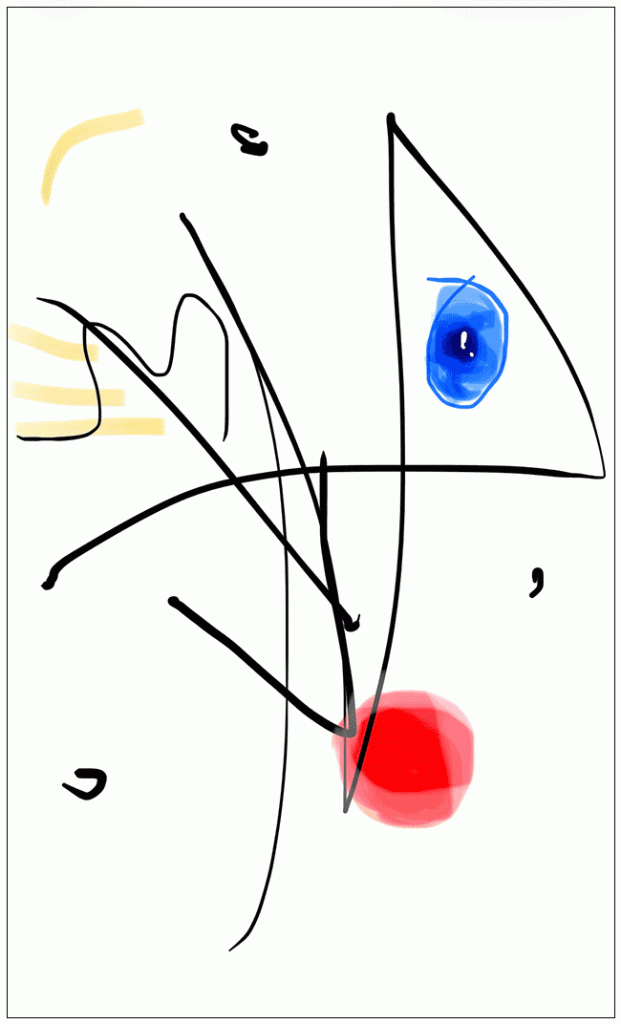
“Dad” moves in a different direction. It is immediate, direct, and unfiltered. Created quickly on an iPhone during a flight, it captures a moment without pause or revision.
The work centers on a personal realization. Her father is understood as a source of guidance, described as both light and direction. The idea of the North Pole suggests orientation, something constant within movement. It speaks to the feeling of knowing where you stand because of someone else’s presence. It is not simply about admiration, but about grounding.
The choice of an iPhone as the medium matters. It removes any distance between thought and image. There is no preparation, no separation between feeling and execution. The drawing exists almost at the same speed as the realization itself. This immediacy gives it a certain clarity. It does not attempt to refine or perfect the idea. It remains close to its origin.
Visually, the work likely reflects that speed. Lines may be loose, forms not fully resolved, but this openness becomes part of its meaning. It mirrors how understanding can arrive suddenly, without structure. The piece holds onto that moment rather than reshaping it into something more controlled.
What connects both works is an interest in what lies beneath the visible. In “Still life – still love,” the hidden portrait reshapes how the surface is understood. In “Dad,” the simplicity of the sketch carries emotional depth beyond what is immediately seen. Neither piece depends on technical complexity. Both rely on clarity of intent.
Navajas is not focused on impressing through technique. Her attention is on revealing something internal. Her work moves between what is seen and what is felt, allowing both to exist side by side without resolution.
She leaves space for contradiction, for quiet tension, and for a kind of understanding that unfolds slowly rather than all at once.
