

The name Peter Parker arrives with its own associations. It carries decades of comic book history, a built-in sense of narrative, and a familiarity that is hard to ignore. So when we received a group of works under that name, it immediately raised a quiet question. Is it real, or is it a reference? The answer, in a way, does not matter. What matters is the role attached to it.
Peter Parker, in this context, is not the hand behind the paintings. He stands in a different position, one that often goes unnoticed. He supports, encourages, and helps sustain the artist responsible for the work. It is a role that rarely asks for recognition, yet it shapes what becomes possible. The paintings themselves draw from the visual language of American comic books, carried through the work of artist Pete “PG” Garcia. Together, this dynamic creates something layered, where authorship, influence, and support all sit in the same space.
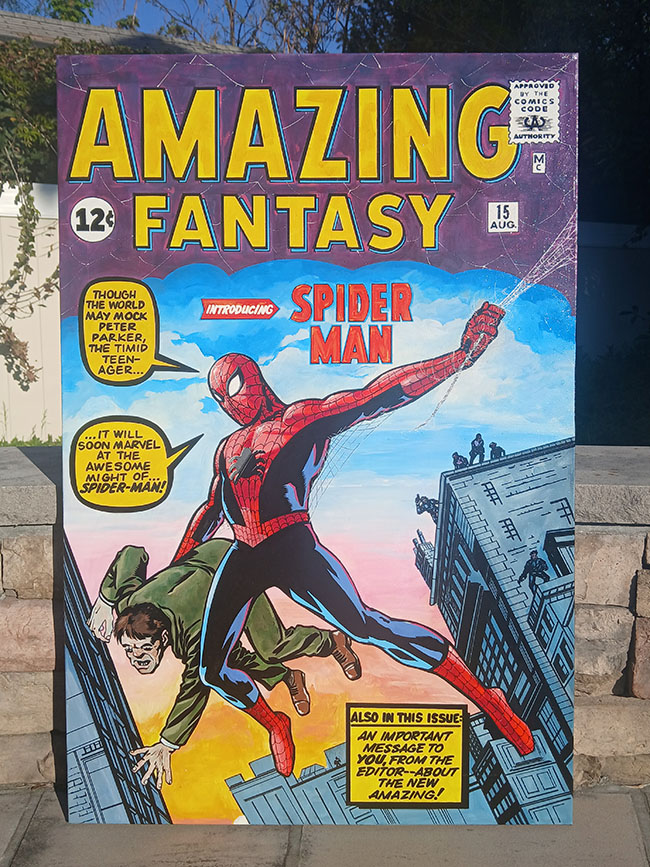
There is something direct about these paintings. They do not hesitate or soften their approach. Instead, they move forward with a clear visual intention, rooted in the structure of American comic book history. You can see it in the composition, in the pacing of the image, and in the way each element competes for attention without losing balance. The work carries echoes of the eras that shaped the medium, from early graphic storytelling to the more dynamic and expressive phases that followed.
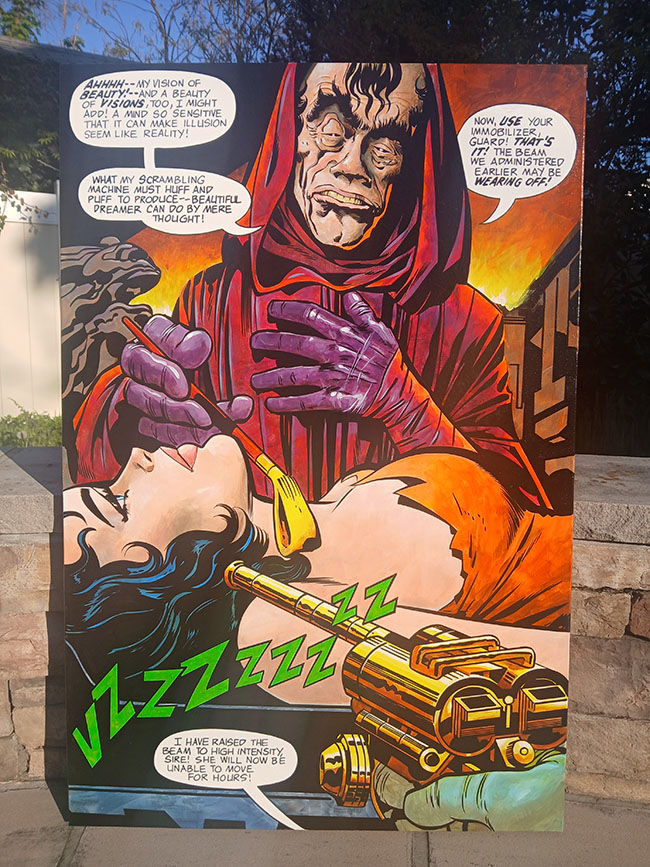
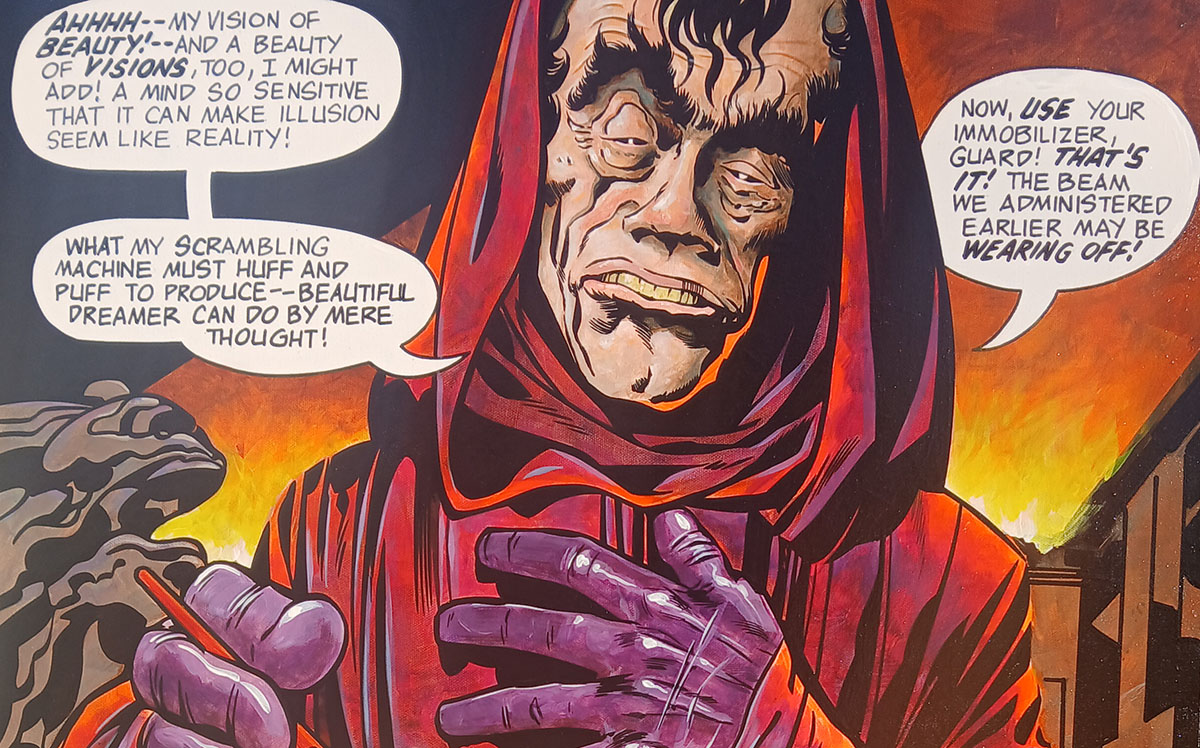
The piece centered around Dessad from Forever People #4 stands as a strong example of this approach. Dessad is not a subtle character. He is constructed to unsettle. Originating from the world of Apokolips, he exists as a servant to Darkseid, but not in any simple sense. He operates within a structure of fear, power, and quiet ambition. His presence is defined by contradiction. He is both loyal and calculating, both submissive and dangerous.
This duality translates directly into the visual treatment. The character does not sit still within the frame. There is tension in the posture, in the way the lines tighten around the form, and in the density of the surrounding space. The image feels compressed, almost as if it is holding something back. That restraint adds to the sense of unease. It is not loud chaos, but something more controlled and deliberate.
The visual language used to construct Dessad follows the tradition established in classic comic work, particularly the bold, structural style associated with artists like Jack Kirby. There is a clear emphasis on form and silhouette. Shapes are pushed to their limits, exaggerated just enough to heighten emotion without losing clarity. This approach allows the character to remain readable even at a glance, which is essential in the context of comic-inspired imagery.
Color, when present, does not act as decoration. It functions as a signal. It directs attention, builds contrast, and reinforces the emotional tone of the scene. In a character like Dessad, color often leans toward extremes. It amplifies the sense of instability and control at the same time. The result is an image that feels active, even when static.
What makes this body of work more interesting is the layered authorship behind it. The paintings are created by Pete “PG” Garcia, yet they arrive under the name Peter Parker. That separation introduces a quiet shift in how the work is understood. It brings attention to the idea that art is not always a solitary act. It can be supported, shaped, and made possible by someone who chooses not to stand in front of it.
In many ways, this mirrors the structure of the comic world itself. Writers, inkers, colorists, and editors all contribute to a final image that often carries a single name. Here, that structure is echoed in a more personal way. The supporter and the artist exist in parallel, each contributing to what ultimately becomes visible.
The reference to Dessad deepens this reading. A character defined by hidden intentions and layered motivations becomes the subject of a work that also carries its own layers of authorship. There is a kind of symmetry in that. The image reflects not only the character it portrays but also the system behind its creation.
This is where the work settles. It does not try to resolve these layers or simplify them. Instead, it allows them to remain visible. The name, the support, the artist, and the subject all stay present at once. That tension is what gives the work its edge. It is not just about what is shown, but about how and why it comes into view at all.
