

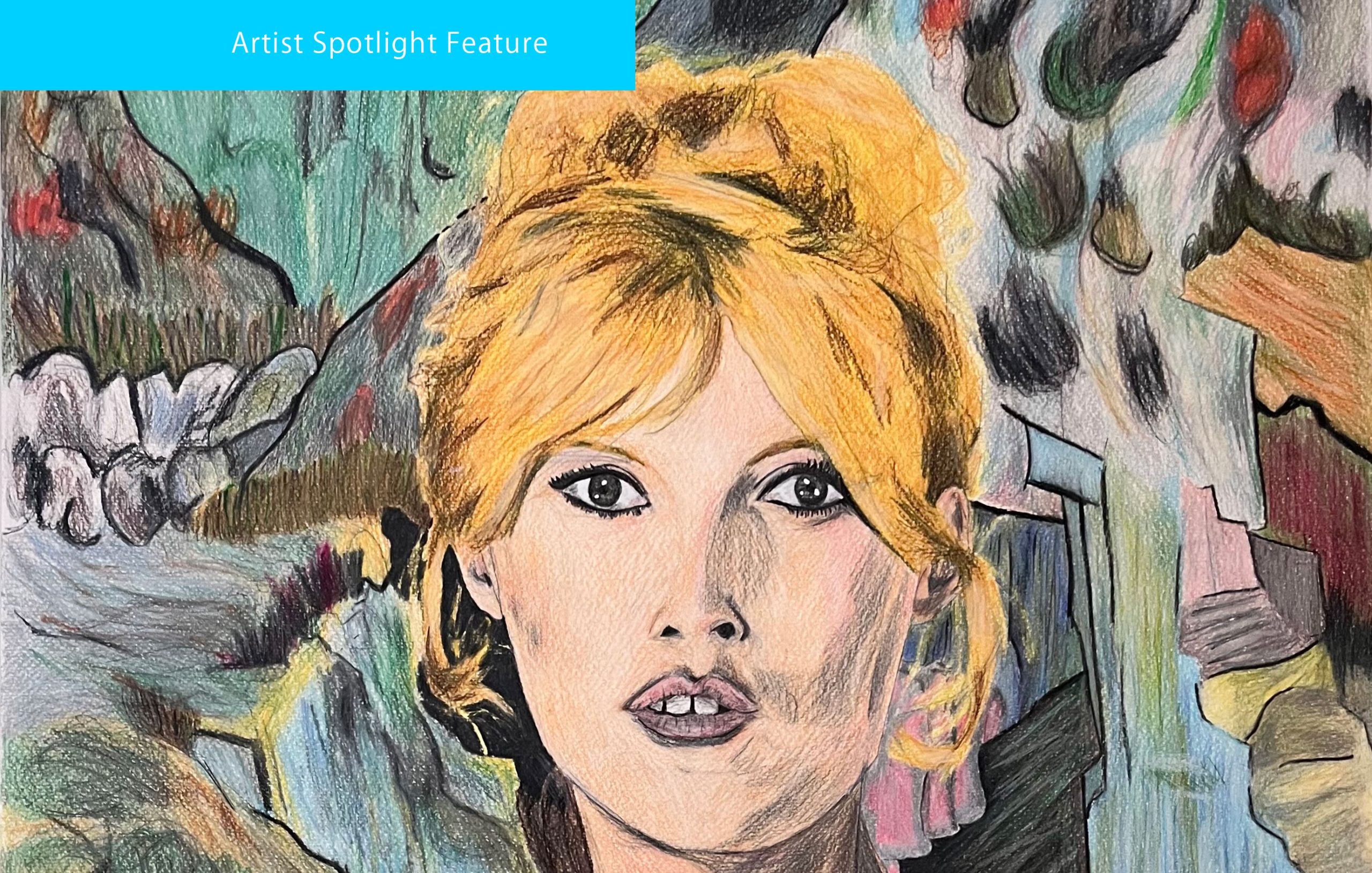
Helena Kotnik works at the intersection of emotion, observation, and imagination. Her studies at prominent European institutions gave her a solid technical base, yet that structure never confines her approach. She completed her Bachelor’s Degree in Fine Arts at Barcelona University and the Akademie der bildende Künste in Vienna, later continuing with a Master’s degree. That academic grounding is present, but it stays understated, supporting rather than directing her process as she moves between intention and instinct.
Her paintings avoid delivering fixed meanings. Instead, they operate as open spaces where reflection can unfold. Rather than guiding the viewer toward a clear answer, they encourage pause and interpretation. Each piece feels like part of a larger, unfolding narrative shaped by memory, cultural context, and the fluid nature of identity. Kotnik allows personal and social elements to coexist within the same surface, sometimes aligning, sometimes pulling against each other. The result feels immediate but reveals additional layers the longer one spends with it.
She describes her work as “psychological human landscapes,” a phrase that captures her focus well. Her paintings are not limited to depicting individuals. They consider the inner and outer environments that shape human experience. Emotions, cultural cues, social roles, and fragments of daily life appear together without a fixed hierarchy. These elements overlap and interact, reflecting the way experience itself is rarely ordered or contained.
Color plays a key role in how these ideas come through. Her palette often feels bright and approachable, sometimes even playful, yet beneath that surface lies a heavier emotional tone. This contrast creates a subtle tension. The viewer is drawn in through color, then held by the complexity that emerges over time.
Kotnik’s work maintains a quiet dialogue with art history, though it never leans on it. References are absorbed rather than repeated. She moves across visual traditions, bringing them into conversation with the present moment. This is less about revisiting the past and more about examining how those influences continue to shape current ways of seeing.
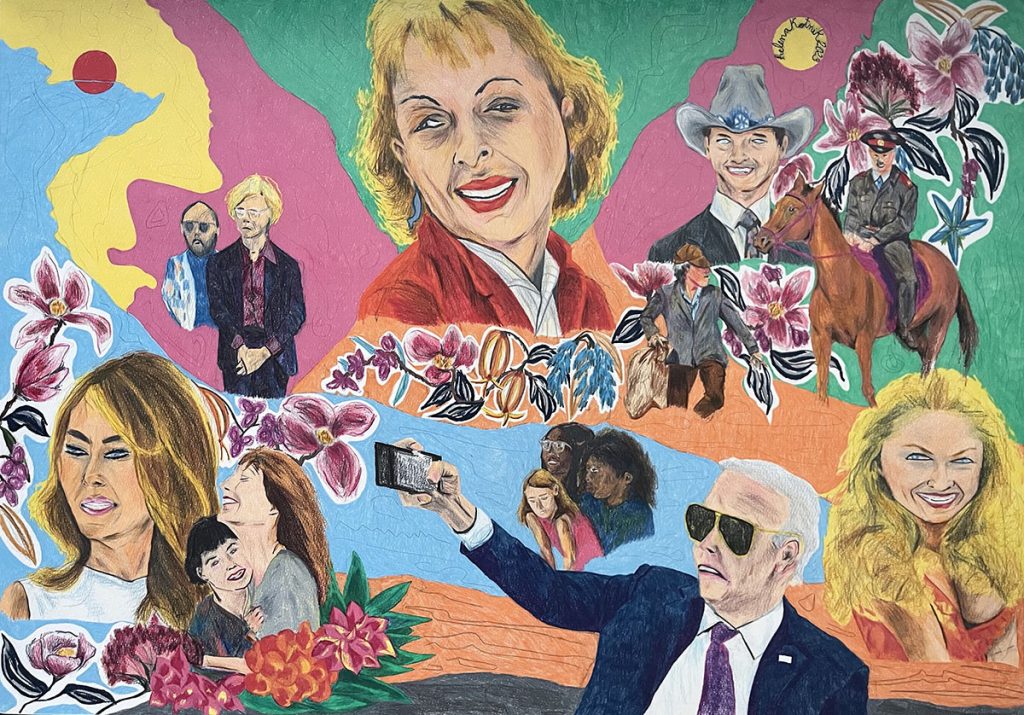
“Cultural Diversity,” created for The Other Art Fair in Dallas, reflects this approach clearly. The painting brings together a wide range of figures and symbols associated with American culture. Recognizable faces appear alongside cowboys, floral elements, and fragments of landscape. The composition feels structured yet open, without a single focal point. The viewer’s eye moves across the surface, forming connections between the various elements.
In this work, identity is presented as something layered and constructed rather than fixed. Dallas becomes more than a location. It acts as a meeting ground for different narratives. The figures share space, visually connected even without direct interaction. There is a sense of coexistence, where differences remain visible but not separated.
The title provides direction without limiting interpretation. “Cultural Diversity” suggests inclusion while also opening up questions. How do different identities exist together? What defines a shared culture? How do individual experiences sit within a larger framework? Kotnik does not resolve these questions, leaving room for personal interpretation.
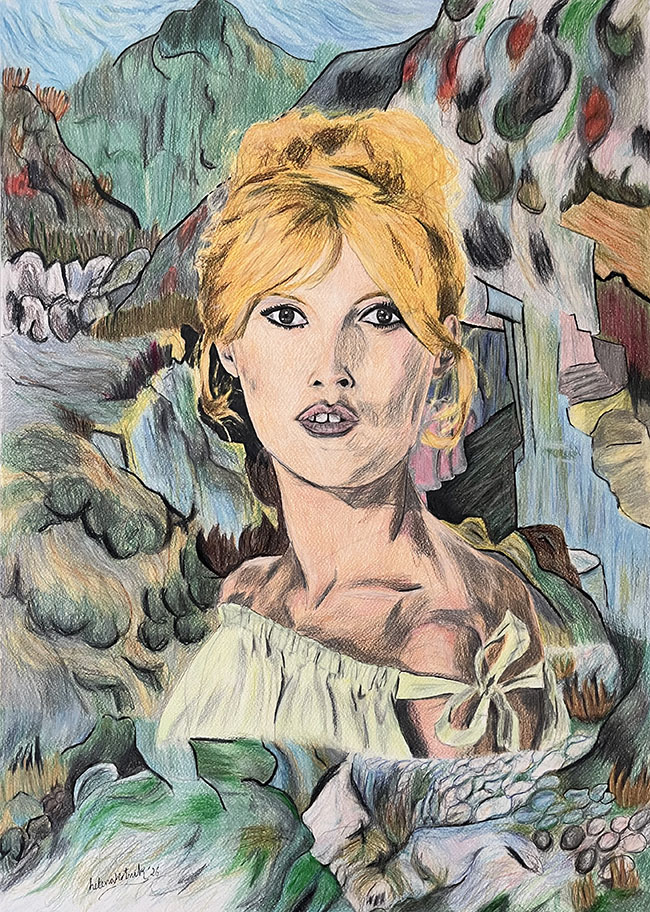
In contrast, the piece titled “Shit” shifts inward. It focuses on a more immediate and personal moment. A single figure occupies the center, surrounded by a fragmented and unstable setting. The space feels psychological rather than physical. Forms blur and shift, and color behaves in less predictable ways, creating a sense of tension where internal and external pressures meet.
The title is direct and unfiltered, setting the tone without hesitation. It removes distance and signals an unedited view of experience. The figure appears caught in a moment of uncertainty, suspended between control and overwhelm. This in-between state gives the work its intensity and keeps it open-ended.
Here, her line work becomes more pronounced. The marks feel exposed, almost raw, revealing the process rather than concealing it. This adds to the emotional weight of the piece. The viewer becomes aware not only of the image itself, but of its making. The act of painting remains visible within the final result.
Across these works, Kotnik maintains a careful balance. Her paintings are accessible without being overly defined, allowing space for multiple interpretations. They invite attention without becoming obscure. Each piece offers an entry point, encouraging viewers to engage on their own terms.
Her work does not attempt to resolve complexity. Instead, it reflects it. Contradictions are allowed to exist side by side, without being simplified. In doing so, her paintings remain active, shifting with each viewing and shaped by the perspective of each person who encounters them.
