

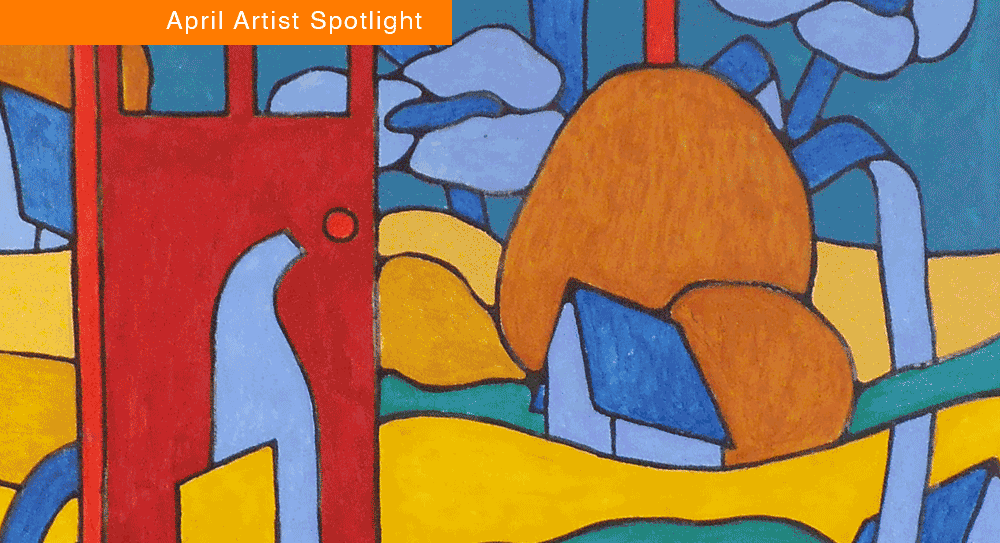
Michel Marant, born on August 4, 1945, in Saint-Junien, France, has built a practice shaped by everyday observation and a steady connection to the natural world. He studied at the National School of Decorative Arts in Limoges and is affiliated with the Maison des Artistes. Over time, he has developed a visual language that feels both intuitive and consistent. His work spans pencil, acrylic, oil, and collage, moving freely across canvas, paper, and cardboard. While traces of art nouveau can be sensed in his flowing lines, his approach is not tied to any one tradition. Instead, he works within his own structure, where line, color, and form interact with clarity. His paintings do not aim to mirror reality. They reshape it, offering a version of the world that feels familiar but slightly shifted.
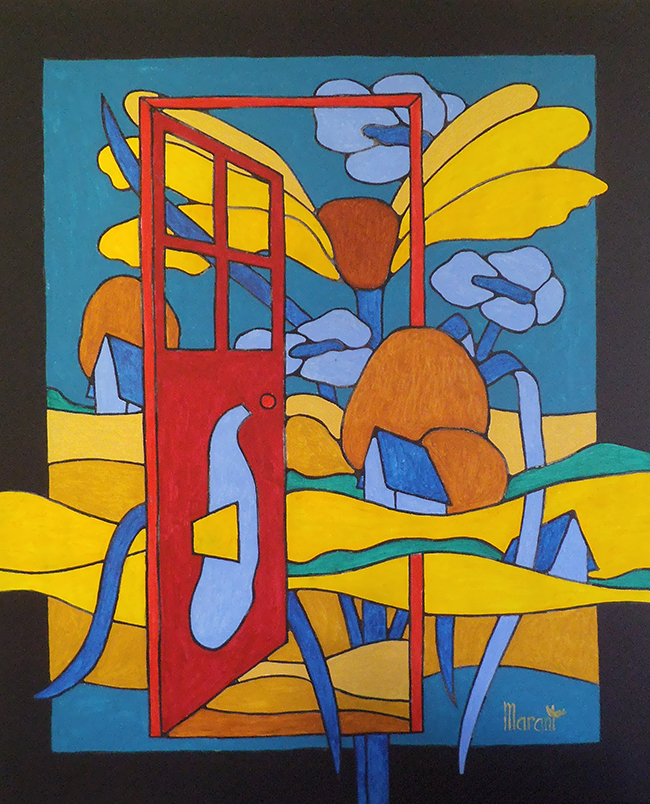
In Opening onto the Dragonfly Flower (2025), Marant builds a composition that sits between openness and enclosure. A red door appears in the foreground, slightly ajar, suggesting both entry and separation. Rather than leading into an interior, it opens onto a landscape formed through simplified shapes and bold color. Horizontal bands of yellow move across the surface, intersected by blue and green elements that suggest vegetation, stones, or fragments of land. Above, stylized flowers rise, their rounded forms repeating and reinforcing the rhythm of the composition.
The door functions as more than a physical object. It acts as a point of transition, framing how the viewer encounters the scene. Entering the image becomes less about moving through space and more about shifting perception. The strong red stands in contrast to the surrounding blues and yellows, creating tension while anchoring the composition. At the same time, everything remains controlled. Details are reduced. Forms are distilled, allowing color and structure to define the image.
The dragonfly flower is not described in a literal way. It is suggested, absorbed into the environment. It becomes part of a symbolic space rather than a direct reference. The landscape itself feels constructed, as if each element has been placed with intention but left open to interpretation. The result is a space that feels grounded yet slightly unstable, where depth and scale do not fully settle.
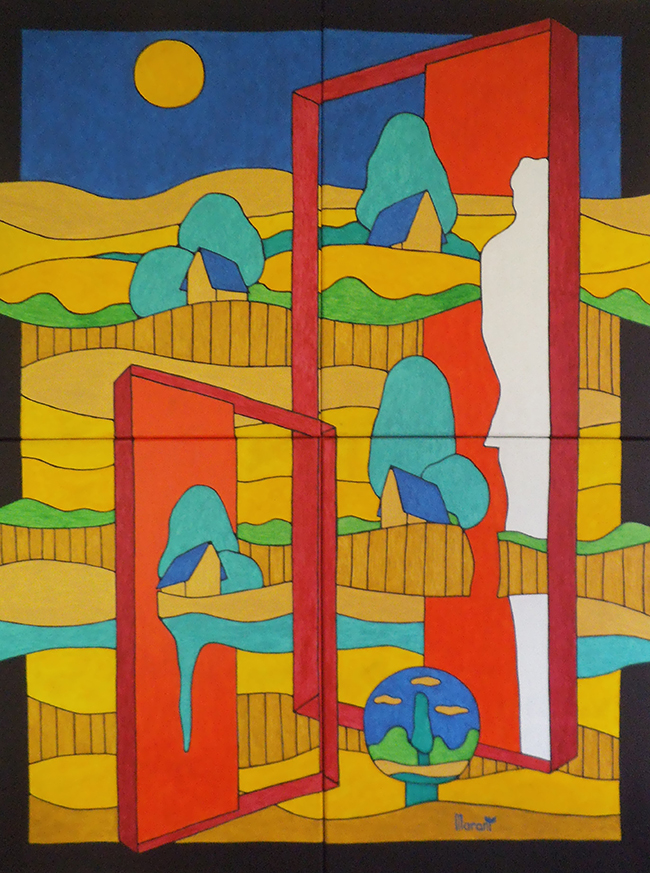
In White Silhouette with Red Frames (2026), Marant continues this exploration, placing greater emphasis on the human presence. A white silhouette stands within a tall red frame, set against a landscape of rolling yellow fields and simplified trees. The figure is reduced to a flat shape without detail, removing any specific identity. It becomes a presence rather than a defined individual.
The red frames recall the door from the earlier work but expand into a more layered structure. One frame encloses the figure, while another tilts forward in the foreground. These overlapping elements disrupt conventional perspective, constructing space through placement rather than depth. The image suggests dimension, but it resists a single, stable viewpoint.
Color once again organizes the composition. The yellow fields extend across the surface, creating continuity. The blue sky, marked by a simple circular sun, brings clarity. Against this backdrop, the red frames assert themselves with strong, uninterrupted lines. The white figure, positioned within this structure, appears both grounded and separate, part of the environment yet removed from it.
Near the bottom of the painting, a small globe-like form introduces an additional layer. Its rounded shape and varied colors suggest a contained version of the larger landscape. This repetition reinforces the idea that the painting operates across different scales. Interior and exterior, figure and setting, coexist without a fixed order.
Across both works, Marant’s approach remains consistent. Forms are simplified, and visual elements are reduced to their essentials. Space is defined through color and line rather than illusionistic detail. Frames, doors, and boundaries appear throughout, not as barriers but as ways of guiding the viewer through different layers of the image.
There is a steady rhythm running through his work. Repeating curves, horizontal bands, and simplified shapes create a sense of flow. Even when contrasts are strong, they are balanced within the composition. This gives the paintings a sense of calm, even as they shift perception.
Marant does not impose a single reading. His paintings offer a point of entry without directing the outcome. The viewer moves through the work, noticing connections and tensions as they unfold. Meaning remains open, changing depending on how the image is approached each time.
