

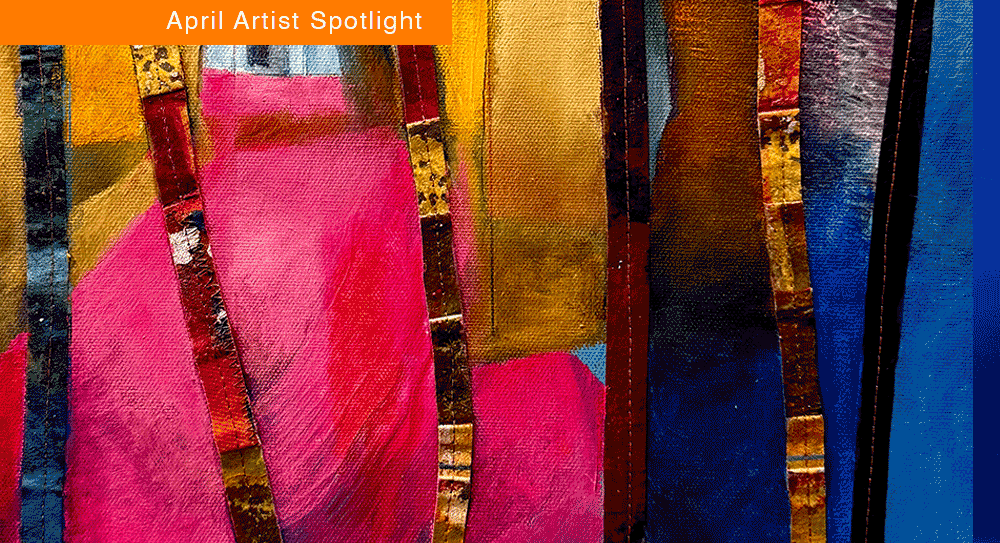
Miguel Barros’s practice grows out of a life shaped by travel, change, and overlapping cultural influences. Born in Lisbon in 1962, his experiences across Portugal, Canada, and Angola continue to inform how he constructs and understands visual space. His relocation from Angola to Calgary in 2014 introduced a new environment, yet Lisbon remains a constant reference point in his work. With formal training in Architecture and Design from IADE in Lisbon, Barros brings a clear sense of structure into his paintings, though it never feels rigid or imposed. Instead, it operates quietly beneath the surface. His work develops in the space between precision and instinct, where composition meets atmosphere, and where memory takes on form. The result is work that feels steady yet open, considered yet fluid.
Lisbon sits at the center of his visual language, though not as a direct representation. It appears as something remembered, shaped by experience rather than observation. The city unfolds through fragments—color, rhythm, and layered forms that hint rather than define. The concept of azulejo moves beyond its connection to ceramic tiles and becomes a framework for thinking about repetition, pattern, and structure. Alongside this, Azul’Tejo carries both a visual and poetic presence, linking the deep blue of the Tagus River to the identity and atmosphere of the city.
Blue plays a defining role in Barros’s work. It is not simply applied; it carries a sense of depth and continuity. It suggests air, water, and distance, stretching across the surface with a quiet persistence. This cooler field is balanced by warmer tones—reds, oranges, and golds—that stabilize the composition. The interaction between these colors creates a subtle tension. The image feels both calm and in motion, as if it is holding opposing energies at once.
His architectural background is visible but never dominant. Rather than constructing clear perspectives, Barros breaks down space into vertical and horizontal divisions. Lines extend across the surface like structural elements, organizing the composition into layered sections. These forms recall buildings and streets, yet they resist settling into a fixed image. The result is a space that feels shifting and open, where different viewpoints overlap.
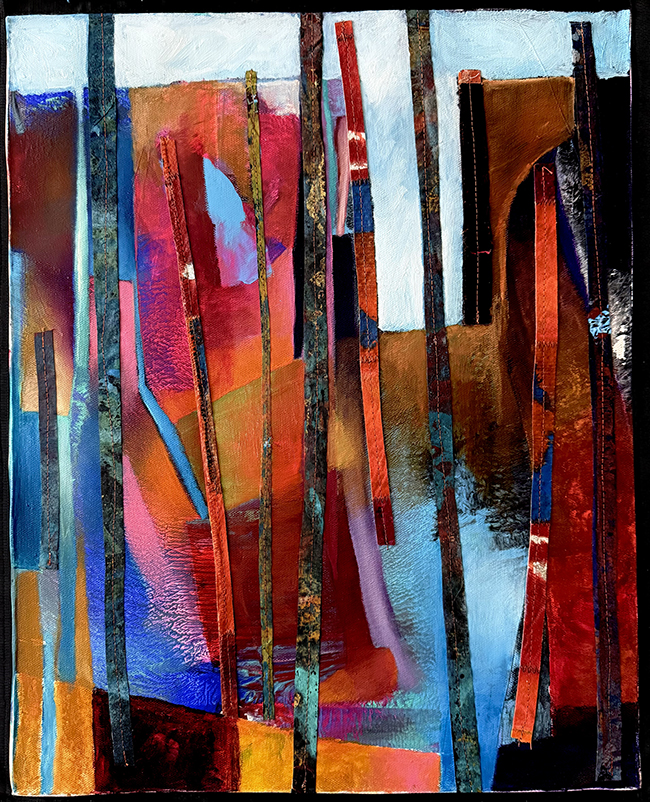
This approach is particularly evident in The Old Cathedral of Lisbon. The painting suggests the presence of a historical structure through arches and openings, yet these elements remain partially hidden. Vertical bands interrupt the composition, cutting through the image and altering its reading. These interruptions create a sense of time passing through the work. The cathedral is not presented as a stable form but as something filtered through memory—distant, reassembled, and transformed.
The surface of the painting reinforces this idea. Layers of paint build upon one another, sometimes revealing earlier marks, sometimes concealing them. This layering reflects the nature of memory itself—constructed, revised, and constantly shifting. The viewer is not given a single, fixed image but is invited to move through fragments, piecing together meaning through observation.
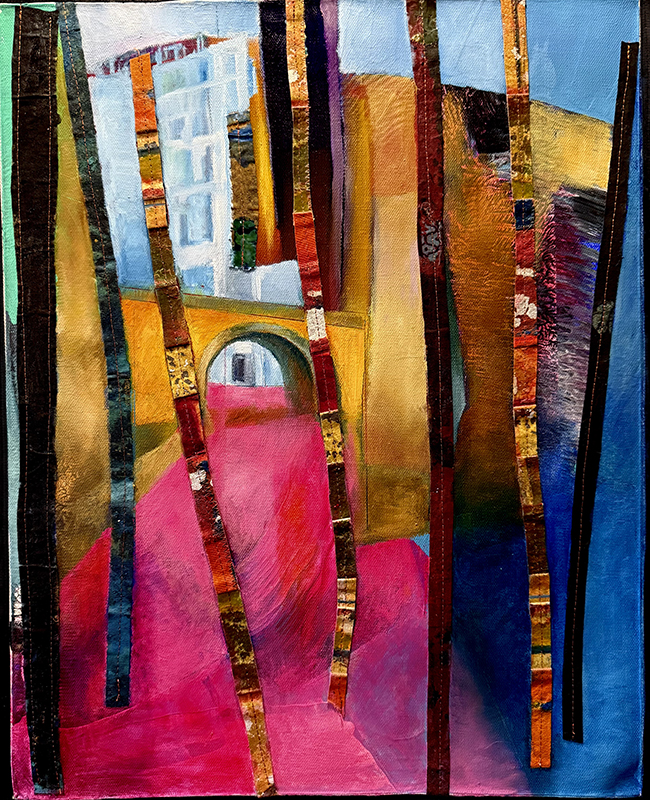
In The Pink Street Lisbon, the atmosphere shifts noticeably. The introduction of pink brings a sense of warmth and immediacy to the composition. While the structural framework remains consistent, the color changes the emotional tone. The street is not depicted directly but suggested through planes of color and directional movement that guide the eye inward.
There is a sense of movement within the work, as if the viewer is passing through the space. Vertical elements continue to divide the surface, acting like markers or fleeting presences. They establish a rhythm that carries the eye across the canvas, giving the composition a steady pulse. The space feels both constructed and in flux, as if it is unfolding over time.
Across both paintings, Barros treats the city as something active rather than fixed. Lisbon becomes a responsive surface shaped by light, memory, and perception. Each wall, passage, and fragment contributes to a larger visual rhythm. The paintings reflect this by avoiding a central focal point. Instead, they encourage the viewer to move across the surface, discovering relationships between color and form.
There is also a quiet sense of distance present. Lisbon is not physically before the artist, yet it remains close. This distance sharpens the emotional clarity of the work. Details are reduced, but what remains feels essential. The aim is not to reproduce the city, but to hold onto its atmosphere.
Barros’s work exists between abstraction and recognition. Specific locations may not be immediately clear, yet a sense of familiarity persists. This allows the paintings to function in multiple ways—as explorations of color and structure, and as reflections on memory and place.
Ultimately, his Lisbon is never fixed. It continues to shift, shaped by recollection and reinterpretation. Through layered surfaces, intersecting lines, and a careful balance of color, Barros transforms the city into an internal landscape—one that can be revisited and experienced differently each time.
