

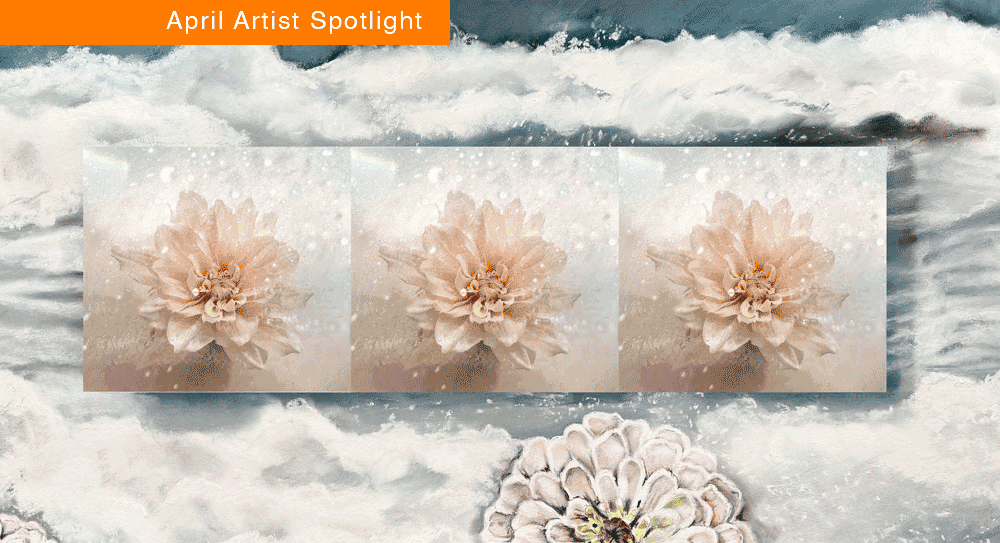
Nancy Staub Laughlin moves fluidly between pastel and photography, blending the two into a unified visual approach. Based in the United States, she studied at Moore College of Art in Philadelphia, where she earned her BFA, a foundation that continues to inform her sense of structure and surface. Her work has appeared in galleries and museums throughout the East Coast and is included in both private and corporate collections. Critics such as Sam Hunter have noted the distinct quality of her work. That distinction comes from her refusal to stay within clear boundaries. Instead of separating mediums or approaches, Laughlin merges them, creating images that feel both deliberate and instinctive.
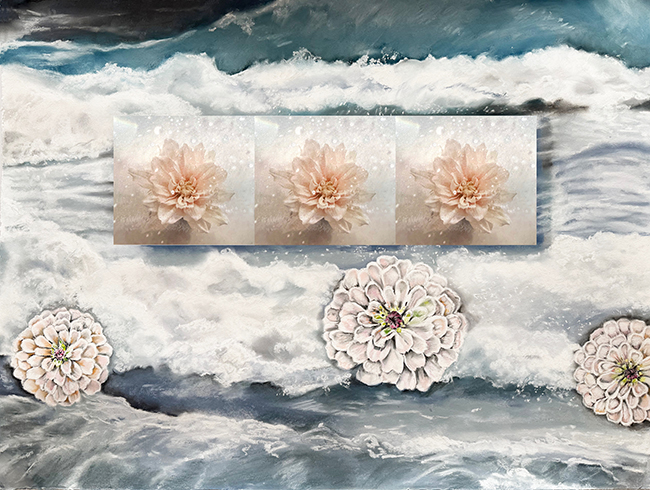
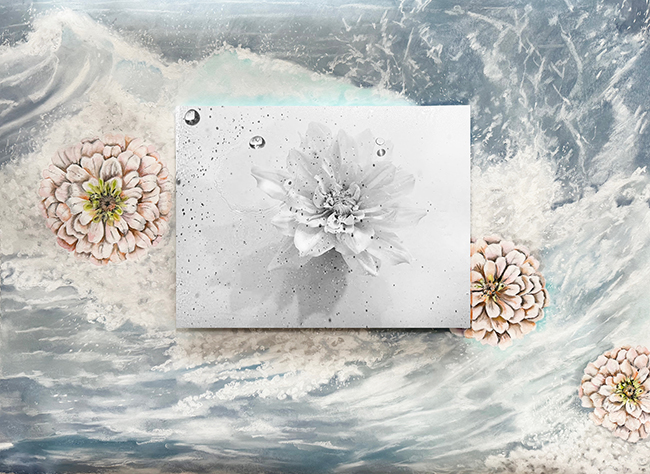
In works like The Floriferous Tides of Froth and The Blooming of Froth, the ocean becomes the core of the composition. It is not simply a backdrop but an active force that shapes the entire image. Waves move across the surface in shifting patterns, breaking and reforming in a continuous flow. This movement creates a visual rhythm that carries the eye across the work. Nothing appears static. The surface feels alive, as if it is still in the process of forming.
From within this movement, floral forms begin to take shape. These blooms are not placed on top of the water but seem to emerge from it, as though they are formed by the same energy. In The Floriferous Tides of Froth, a central flower appears in grayscale, set apart from the surrounding tones yet still tied to them through texture. It feels suspended, hovering within the composition. Around it, softer blooms repeat the form in subtle variations. The shift between monochrome and muted color draws attention inward, creating a quiet focal point within the movement.
In The Blooming of Froth, the composition expands outward. Instead of focusing on a single bloom, three flowers are arranged across the center in a horizontal line. This interrupts the upward and downward motion of the waves, shifting the way the image is experienced. The eye travels across the sequence before returning to the movement of the water. The tones here are warmer, but the sense of motion remains. The flowers do not feel still. They appear to carry the same energy as the ocean, as if they are part of its ongoing rhythm.
The interplay between pastel and mounted photography is essential to the work. The photographic base provides depth and a sense of reality, grounding the image. Pastel is then layered over it, softening the surface and introducing atmosphere. This combination creates a textured, layered effect where light seems to exist within the image rather than sitting on top of it. Some areas remain sharp, while others dissolve, allowing clarity and ambiguity to exist side by side.
There is also a subtle tension in how space is handled. The ocean suggests distance and openness, extending beyond the frame. The flowers, on the other hand, often feel closer to the surface, slightly compressed. This creates a push and pull between depth and flatness. The viewer is held between these two spatial experiences, never fully settling into one. This tension adds to the sense of movement that runs through the work, even in still moments.
Rather than presenting a clear narrative, Laughlin builds an atmosphere. Through repetition, layering, and the balance between control and fluidity, a mood begins to take shape. The palette carries a sense of calm, yet there is always an undercurrent of motion. The ocean can feel both quiet and restless at once. The flowers, often associated with stillness, shift into something more dynamic, becoming part of the same flow.
Her work asks for time. It does not reveal everything at once. Instead, it opens slowly, allowing details to emerge through careful looking. Small shifts in color, texture, and form begin to connect, softening the contrast between elements. Water and bloom, stillness and movement, photography and pastel begin to operate together within a shared language.
Through these works, Nancy Staub Laughlin does not aim to reproduce the natural world as it is seen. She reshapes it, allowing its elements to merge and transform. The result feels both familiar and altered, grounded in reality but guided by imagination.
