

Sebastian Di Mauro’s work is shaped by distance and relocation. Raised in Australia and later settling in the United States, he stepped into a cultural environment that felt at once familiar and strange. Much of what he had understood about America had been filtered through media—films, television, and the broader mythology of the American Dream. Living there shifted that perception. Alongside a partner with ties to Wilmington, Delaware, he began navigating between expectation and experience, between what had been imagined and what unfolded in real time. That tension continues to inform how he approaches both material and meaning.
In his practice, identity is not treated as something fixed. It shifts, accumulates, and changes depending on context. This sense of instability is reflected in how he builds his work. He uses found textiles, existing imagery, and layered stitching, choosing surfaces that already carry their own histories. Rather than removing or replacing those histories, he works into them. The process becomes one of interruption and adjustment. Memory and place are not presented as stable narratives. They are reworked, pulled apart, and reconsidered.
There is a subtle friction present across his pieces. What is visible is only one layer. Beneath it sits another structure, one that emerges through intervention. Found tapestries are central to this approach. These objects often depict calm, resolved scenes—landscapes or historical moments that feel complete. Di Mauro resists that sense of closure. Through stitching, he unsettles the image, allowing it to shift into something less certain.
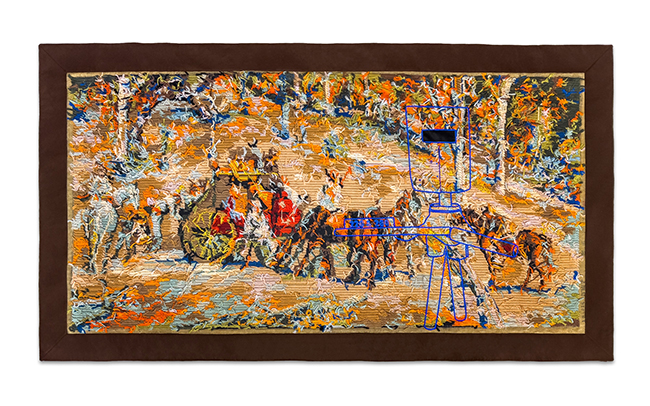
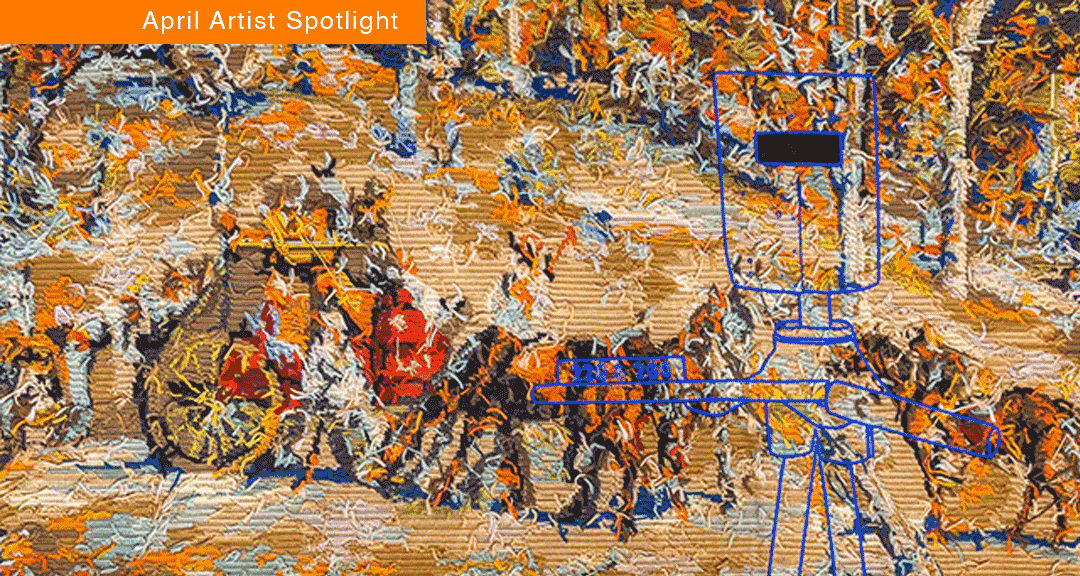
In Bolters (2026), this approach intersects directly with Australian history. The work begins with a found tapestry printed on Twill Waratah textile, bordered in green felt and altered through hand-stitched blended yarn. The scene suggests a familiar image: bushrangers stopping a stagecoach. The reference to Tom Roberts’ Bailed Up (1895) is present, but it is not treated as authoritative. Instead, it becomes a point of departure.
Within this scene, an unexpected element appears. Ned Kelly is introduced, though not in a traditional form. He takes shape as a letterbox made from scrap metal, bearing the numbers of two rural homes in the Northern Highlands of New South Wales. The gesture feels grounded in observation, as if it originated from something encountered rather than constructed. At the same time, it carries a strong cultural resonance.
This shift alters the reading of the work. Kelly is no longer confined to a historical image or narrative. He enters the everyday. The letterbox, ordinary and functional, becomes a point of connection between past and present. By placing it within the composition, Di Mauro reduces the distance between myth and lived experience. The figure of rebellion no longer sits apart from daily life. It becomes part of it.
The stitching plays a key role in this transformation. It moves across the surface in visible lines, never attempting to disappear. Each stitch marks an intervention, adding another layer to the work. The original tapestry remains intact, but it no longer holds authority on its own. It becomes unstable, open to change. Bolters moves away from simply referencing history and instead examines how such images continue to shift and reappear in new forms.
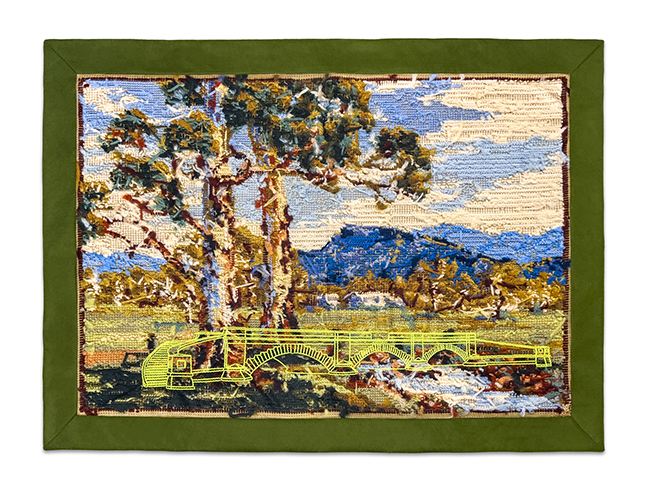
In Abridged Landscape (2026), the focus turns toward absence rather than presence. The work begins with the reverse side of a traditional landscape tapestry, printed onto fabric. This inversion is significant. The back of the tapestry reveals its construction—the threads and structure that are usually hidden. By bringing this side forward, Di Mauro shifts attention to what typically remains unseen.
Onto this exposed surface, he stitches the outline of the Ross Bridge in Tasmania. The bridge carries a specific historical weight, having been built by convict labor. This reality contrasts with the calm, idealized landscapes often associated with tapestry imagery. Where the original image suggests balance and stillness, the stitched addition introduces a more layered narrative.
Here, stitching operates as a form of re-entry. It does not erase the underlying image but insists on another presence. The bridge emerges slowly, constructed through thread rather than illusion. This process changes the pace of viewing. It draws attention to how the image is made, and to what has been left out.
Abridged Landscape brings focus to the gaps within representations of place. Landscapes that appear peaceful often rest on histories that remain unspoken. By introducing the Ross Bridge, Di Mauro points to the systems of labor and control tied to colonial settlement. The work does not dramatize this history. It allows it to surface quietly, through material and process.
Across both works, a clear approach becomes visible. Di Mauro does not begin with an empty surface. He starts with something that already exists—an image, a textile, a fragment—and works into it. This method mirrors his engagement with memory and identity. Just as his own experience moves between locations, his works exist between conditions. They are neither entirely new nor entirely inherited.
The result is a practice that avoids resolution. The surfaces remain layered and open, allowing for multiple readings. History is not presented as fixed. It is something that can be revisited and adjusted. Through stitching, layering, and recontextualizing, Di Mauro creates works where different moments in time sit alongside each other, held in an ongoing exchange.
