

Adamo Macri works across disciplines without settling into a single form. Born in Montreal in 1964, he trained at Dawson College, where his studies ranged from commercial art and graphic design to photography, art history, and fine arts. That wide foundation still informs how he approaches making. While sculpture is often associated with his name, his work moves just as naturally through video, painting, drawing, and photography. Each medium becomes a way of working through the same concerns. Rather than separating them, he allows them to overlap. His practice consistently returns to questions of identity, change, and the gap between what is presented outwardly and what remains internal. Faces and figures appear often, but they do not behave like traditional portraits. They feel constructed, unsettled, and suspended between recognition and invention.
The Work

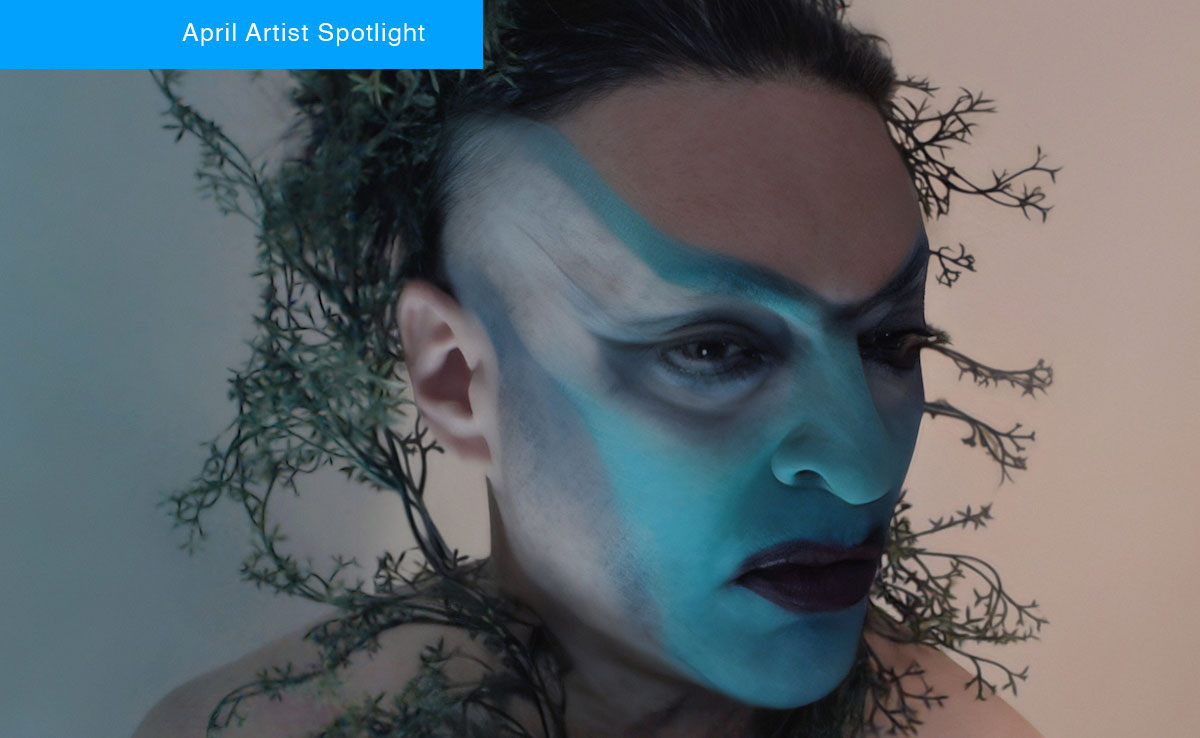
In Hinterland (2016), Macri shifts the idea of landscape away from geography and into the mind. The word itself usually points to a remote region beyond a central place, but here it becomes a space within. The face functions as that hidden zone—a place behind what is visible, beyond the surface of identity. The figure does not feel grounded in a stable self. Instead, it appears disconnected, as though it exists outside any clear framework.
The image is immersed in aquamarine, creating a sense of depth and suspension. The head emerges through a dense, ambiguous mass that could be read as plant life, sea matter, or tangled strands of hair. This material does not simply sit around the figure—it merges with it. The separation between body and environment collapses, leaving the figure embedded within its surroundings. It feels as though it has surfaced from an unfamiliar place rather than being deliberately formed.
The face itself remains restrained. The lips are dark and still, offering no clear emotion. There is no expression to guide the viewer. Meaning develops instead through tone and atmosphere. The work avoids direct explanation, holding attention in a state of uncertainty. The figure seems caught between conditions—neither entirely human nor completely other.
Macri has described the presence as something both recognizable and strange—possibly aquatic, possibly terrestrial, with hints of cultural reference and something slightly alien. These overlapping traits prevent it from settling into a single identity. It carries fragments from different origins without fully belonging to any of them. That sense of removal is central. The figure feels as though it has drifted away from somewhere known, now existing without a fixed point of return.
A maritime suggestion runs quietly through the work. The head can be seen as a figurehead separated from a ship, no longer tied to its original purpose. Once removed, it becomes something else entirely—a presence rather than an object. This shift from ornament to character is important. The figure appears to have moved into its own space, no longer attached to the structure that once defined it.
Music also plays into the construction of the piece. Macri has referenced David Bowie and the track Red Sails as an early influence. The idea of moving toward a distant, unfamiliar place—where language and identity begin to break down—echoes through the image. The figure seems to exist within that distance, occupying a space where meaning is present but not fully formed.
Hinterland connects to a broader direction in Macri’s work, where identity is treated as unstable. Kenneth Radu has drawn a link between this piece and Memento Mori (2014), noting how both works examine the divide between surface and interior. In each case, the outer layer—whether built through texture, setting, or form—acts as both a covering and a point of access.
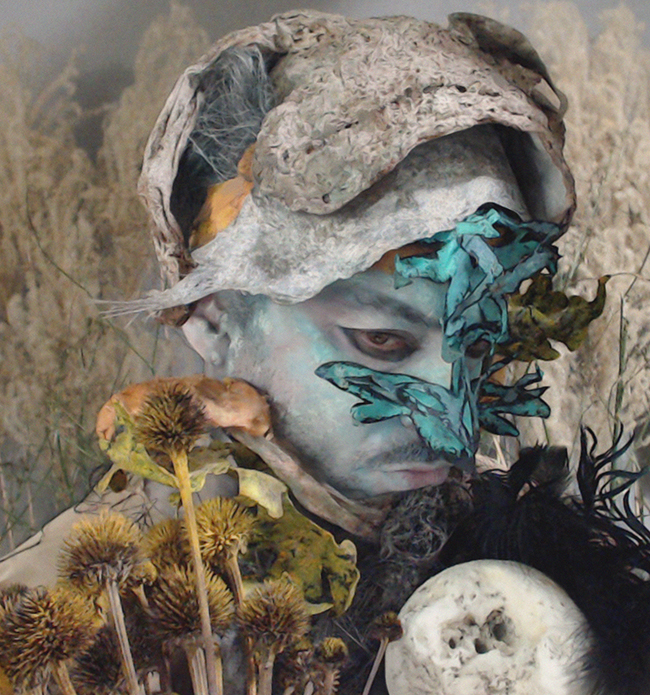
In Memento Mori, the focus shifts toward time and mortality. While Hinterland opens into a space of movement and transformation, Memento Mori turns attention to limits and endings. The title, tied to the idea of remembering death, places the work within a long-standing tradition. Yet Macri approaches it through his ongoing interest in how identity is formed and altered.
The figure in Memento Mori extends beyond a simple reminder of death. It reflects the roles and appearances carried throughout life. As in Hinterland, what is visible only tells part of the story. Beneath the surface, something remains unsettled. Mortality becomes more than a final point—it suggests an ongoing process, where identity continually shifts and reconfigures.
Across both works, resolution is deliberately withheld. Macri does not present identity as something fixed or easily understood. Instead, his figures remain suspended in between—between human and nonhuman, clarity and uncertainty, presence and absence. They do not offer answers. They remain open, inviting interpretation without directing it.
Seen together, Hinterland and Memento Mori form part of a larger inquiry. The figure is not treated as stable or complete, but as something in motion—layered, changing, and unresolved. Macri’s work stays within that shifting space, where identity is never fully settled, but always in the process of becoming something else.
