

Jane Gottlieb has created an unmistakable artistic style rooted in her fascination with vivid color, dynamic movement, and visual rhythm. Raised in Los Angeles and currently based in Santa Barbara, she began her creative career as a painter before expanding into photography. More than 30 years ago, Gottlieb started applying paint directly to individual Cibachrome prints, establishing a technique that would become central to her practice. Through this process, the photographic image is no longer a fixed record of a place or moment. Instead, it becomes a surface for experimentation and reinvention. Intensified colors alter the mood of buildings, cityscapes, and cultural landmarks, transforming familiar subjects into highly expressive environments. Blending the immediacy of photography with the physical presence of painting, Gottlieb creates images in which the visible world is reshaped through memory, emotion, and imagination.
Cities Reimagined Through an Electric Palette
Color is not simply an embellishment in Gottlieb’s work; it determines how each location is experienced. Although many of her compositions originate from recognizable architecture and real urban settings, she moves beyond literal representation. Her heightened palette changes the emotional tone of a scene, allowing an ordinary photograph to become theatrical, dreamlike, or mysterious. Photography establishes the underlying structure, while her painterly interventions release the image from the limitations of everyday reality.
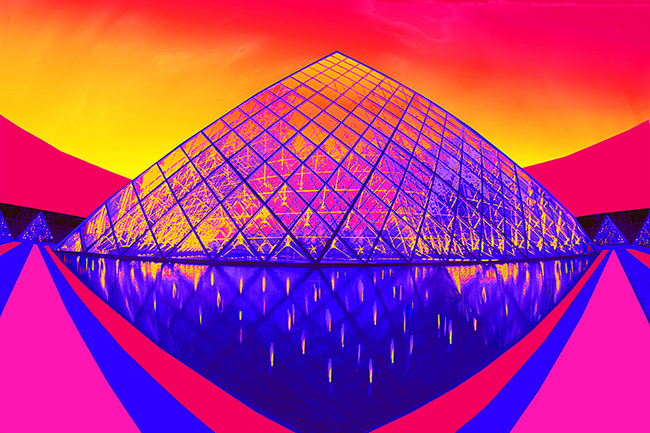
In Paris Pyramid at Dusk, the Louvre Pyramid commands the center of the composition. Its sharp geometry provides balance and precision, while brilliant colors give the landmark an unexpected sense of energy. Violet lines trace the pyramid’s glass framework, and intense shades of pink, orange, and gold spread across the structure and surrounding sky. Below, the reflective water is transformed into a rich field of blue and purple, punctuated by scattered areas of light.
The pyramid’s central point acts as a visual anchor. Diagonal lines lead the viewer inward, reinforcing the strength and symmetry of the architecture. Yet the vivid palette prevents the scene from feeling static. The sky burns with colors that suggest both sunset and artificial illumination, while the water appears almost detached from the natural world. Through Gottlieb’s interpretation, this familiar Parisian landmark enters an uncertain space between the real and the imagined. It could represent an evening in Paris, a remembered journey, or a futuristic vision of the city.
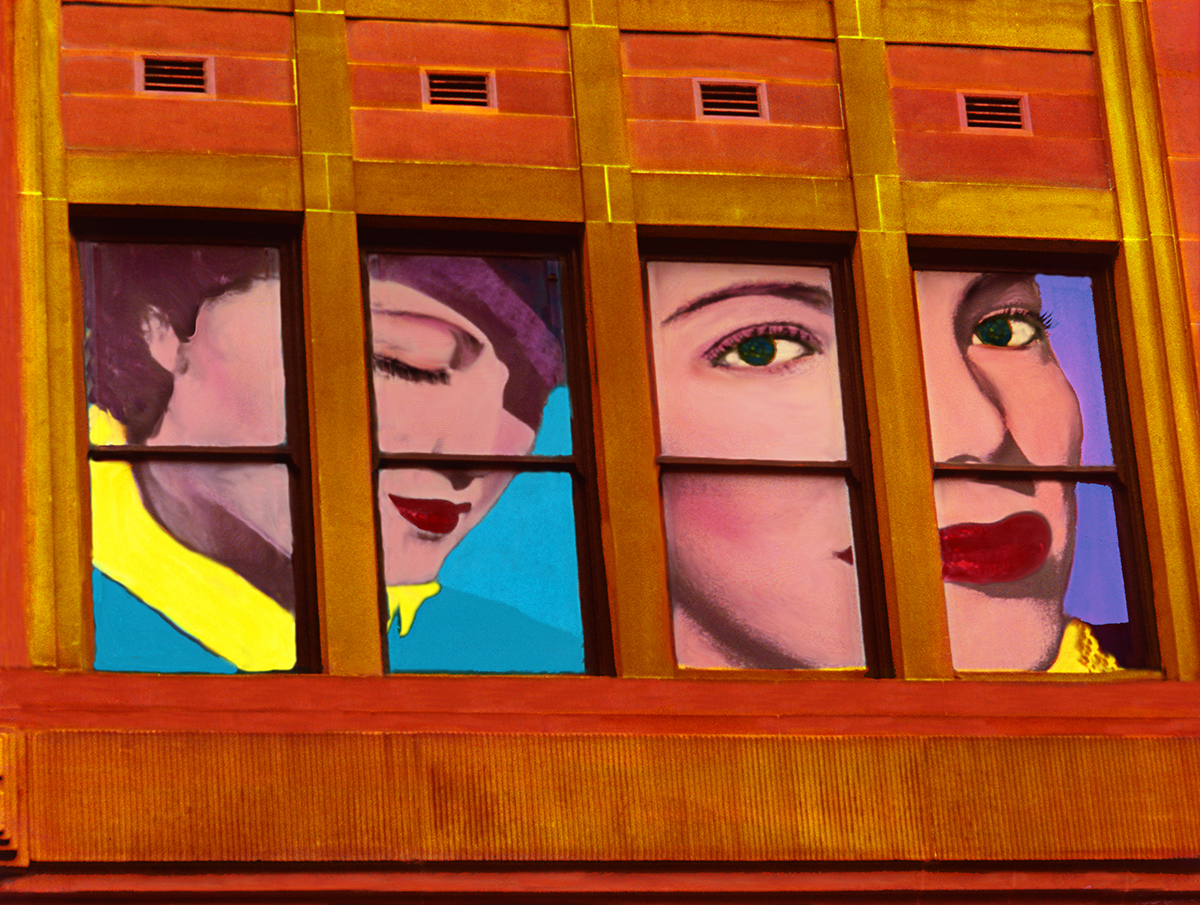
Architecture plays a different role in Window Ladies. A series of windows separates several women into individual sections, turning the building’s façade into a grid of partial portraits. Each woman occupies her own visual space. One appears in profile, another lowers her gaze, and two larger faces look beyond the boundaries of the image. Although they are positioned close together, their different expressions and directions of attention create a sense of psychological distance.
With its bold turquoise, yellow, pink, red, and violet tones, the image recalls fashion imagery, cinema, and vintage advertising. The women possess a polished and dramatic presence, yet the windowpanes divide their faces and keep them behind a physical barrier. They are visible to the viewer but remain emotionally unreachable. This separation introduces questions about privacy, identity, and observation.
The composition also suggests an unfinished narrative. The women may share the same location, but their relationship to one another is unclear. Each appears absorbed in a private moment. Gottlieb offers no definitive explanation, allowing viewers to imagine what may have happened before or after the scene. This uncertainty gives the image the quality of a film still taken from a story whose larger context remains hidden.
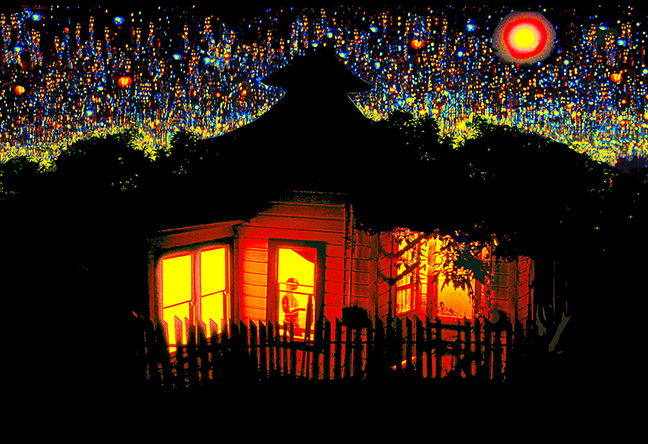
A quieter and more enigmatic atmosphere defines China Town Full Moon Lady. Darkness occupies much of the composition, while the roofline forms a sharp division between the distant city and the illuminated room below. Across the upper portion of the image, countless points of blue, orange, yellow, and red create a restless pattern of urban light. From a distance, these lights begin to lose their individual identities and form an abstract field of color.
Near the lower center, a lone figure stands inside a brightly lit window. Surrounded by intense yellow and red, the person immediately becomes the emotional center of the scene. The house may offer shelter, but it also reinforces the figure’s isolation. Outside, the city appears vast and active, while the interior feels private, still, and enclosed.
The full moon introduces another warm source of light. Its circular rings echo the colors glowing from the windows and create a subtle relationship between the solitary figure and the sky. The moon may be read as a watchful eye, a beacon, or a distant presence overlooking the nighttime landscape. This repeated use of light connects the intimate interior with the larger world beyond it.
Together, these works reveal Gottlieb’s ability to explore architecture, portraiture, and urban storytelling through a consistent visual language. Pyramids, windows, rooftops, and reflections are active elements that organize each composition and influence its emotional meaning. Geometry creates order, shadows produce mystery, and saturated colors bring movement to otherwise still surfaces.
Gottlieb ultimately challenges the idea that photography must describe the world exactly as it appears. Her images remain connected to actual places, yet their transformed colors open those places to new interpretations. Through her combination of photography and painting, reality becomes flexible, emotionally charged, and imaginative. Her work invites viewers to see familiar environments not only as physical locations, but also as spaces shaped by memory, fantasy, and personal perception. Her work combines photography, painting, and Photoshop.
