

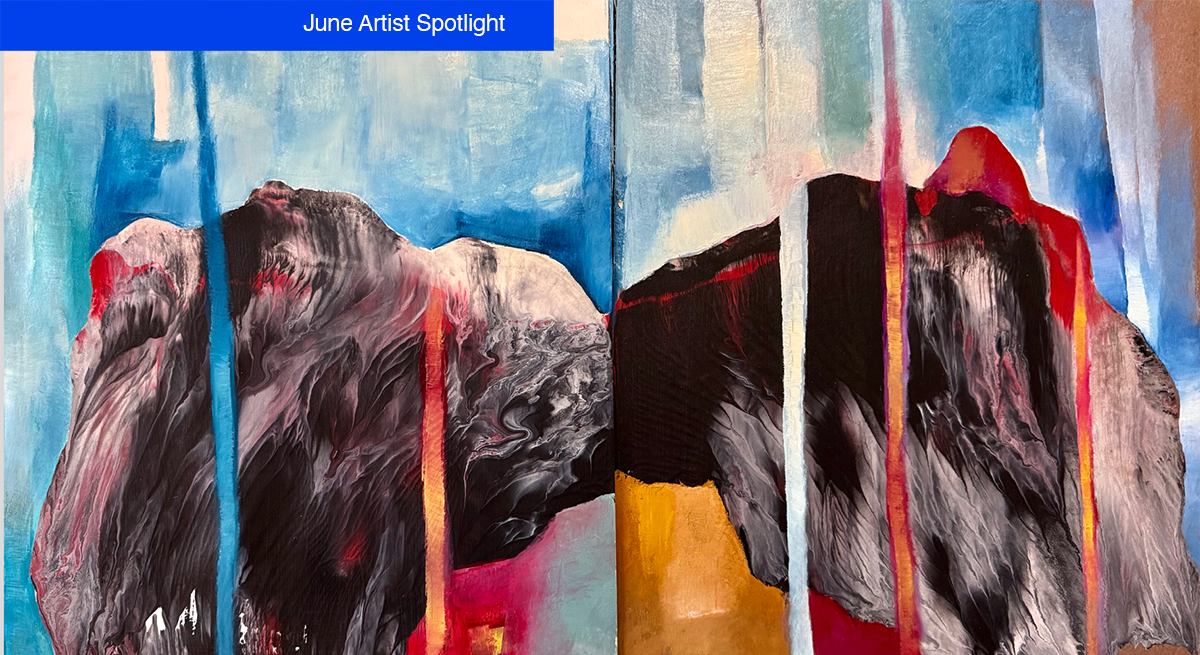
Born in Lisbon in 1962, Miguel Barros has developed an artistic practice shaped by life across multiple continents and cultures. His experiences in Portugal, Angola, and Canada have contributed to a visual language informed by observation, transition, and personal reflection. Since relocating from Angola to Calgary in 2014, Barros has found himself increasingly drawn to the memory of Lisbon. Though physically distant from the city, his connection to it has only grown stronger. In his paintings, Lisbon is less a geographical destination than an emotional presence—rebuilt through recollection, imagination, and longing. This relationship with place runs throughout his work, where memories, lived experiences, and inner narratives merge. Through painting, Barros examines themes of belonging, spirituality, identity, and the ways in which certain places continue to shape us long after we have left them behind.
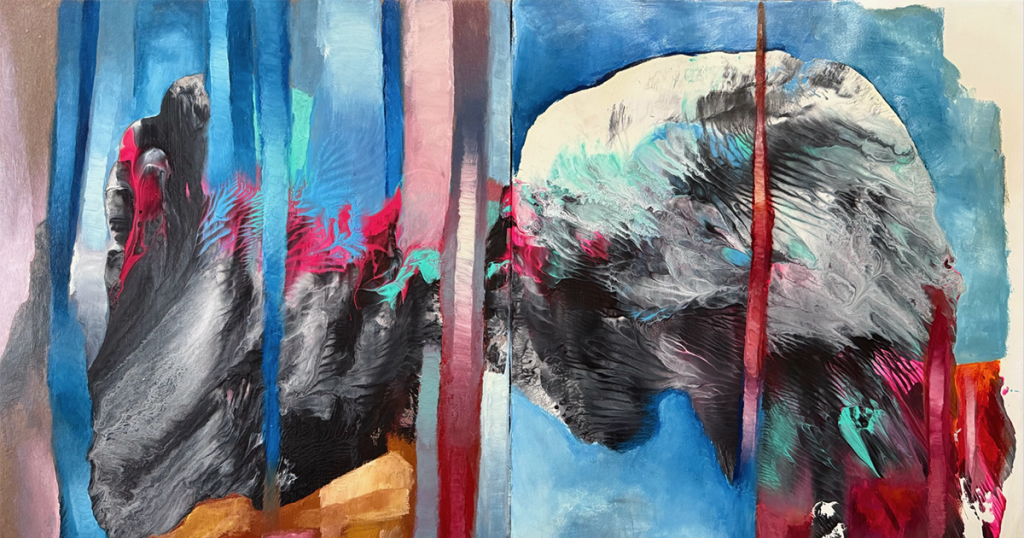
Angels and Demons — Allegories of Human Protection
Miguel Barros’s series Angels and Demons — Allegories of Human Protection investigates the enduring struggle between opposing forces that influence human life. Moving beyond simple notions of good and evil, the paintings explore protection, vulnerability, resilience, fear, and the search for balance in an increasingly uncertain world. Through symbolism and expressive abstraction, Barros creates a body of work that speaks to both personal experience and shared human realities.
Inspired by the rich traditions of sacred painting and classical allegory, the series borrows visual echoes from Renaissance and Baroque art while addressing concerns that remain relevant today. Rather than recreating historical religious scenes, Barros uses familiar symbols as a foundation for broader reflections on morality, human behavior, and emotional endurance.
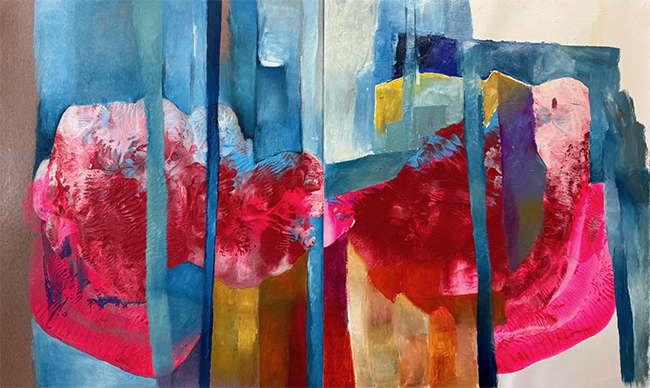
The angelic forms that appear throughout the series function as symbols of guidance, hope, and protection. They are not defined by specific religious identities but instead represent qualities that transcend culture and belief systems. Emerging from fields of light, these figures embody perseverance, compassion, and the capacity to withstand adversity. Their presence serves as a reminder that strength can be found even in moments of uncertainty and instability.
Opposing them are the demons, which Barros treats not as mythical creatures but as visual representations of humanity’s darker impulses. Fear, aggression, intolerance, hopelessness, and excessive ambition become the true subjects behind these forms. By presenting demons as psychological and social realities, the artist encourages viewers to consider how these forces operate within contemporary life and within ourselves.
A defining characteristic of the series is its emphasis on hope. Although the works are filled with tension and conflict, they never descend into despair. Throughout the paintings, protective forces remain present, suggesting that goodness possesses its own quiet strength. The struggle is real, but so is the possibility of renewal. For Barros, resilience emerges not through dominance but through persistence, compassion, and an unwavering commitment to preserving what is human.
The paintings themselves are rich in atmosphere and emotion. Executed in oil on fabric and paper, the works feature layered surfaces, energetic brushwork, and textured applications of paint that create a sense of depth and movement. Light serves as a central element within the compositions, often breaking through darker passages and transforming the emotional tone of the image. These dramatic contrasts create a visual tension that reinforces the themes explored throughout the series.
Color is equally important to the narrative. Dense shadows and darker palettes evoke uncertainty and inner conflict, while luminous tones introduce moments of hope and spiritual elevation. The dialogue between darkness and illumination becomes a metaphor for the larger themes that run throughout the collection.
Many of the angelic figures appear on a monumental scale, commanding attention while remaining abstract enough to invite interpretation. Their forms are intentionally open-ended, allowing viewers from different backgrounds to connect with them through their own experiences and perspectives. This universality strengthens the emotional reach of the work and encourages a personal encounter with its themes.
Part of the Angels and Demons series will be included in a collective exhibition in Rio de Janeiro, Brazil, in June 2026, bringing the work into conversation with new audiences and expanding its engagement with contemporary artistic discourse.
At its core, Angels and Demons — Allegories of Human Protection is a reflection on humanity itself. Through symbolic imagery, layered compositions, and emotionally charged atmospheres, Miguel Barros explores the forces that challenge, protect, and sustain us. The series suggests that while darkness remains a constant presence, so too does the possibility of hope. Steady and enduring, it continues to illuminate a path forward.
