

L. Scooter Morris approaches painting as a physical and perceptual encounter. Calling herself a sensory illusionist, she creates works that challenge the boundary between image and object. Her signature Sculpted Paintings® are formed through acrylic and mixed media, with built-up surfaces, textured ridges, embedded materials, and pronounced shadows. These features cause each composition to respond differently to light, distance, and the viewer’s position. From across a room, the work may resemble an expansive landscape. At close range, its layered construction becomes increasingly visible. Morris encourages this changing experience, inviting the viewer to move around the painting rather than observe it from a single fixed point. Her art is not intended simply to complement an interior. It is meant to create a physical and emotional reaction. Through material, movement, and optical uncertainty, Morris transforms painting into something that feels dimensional, changeable, and alive.
Written History Across the American Landscape
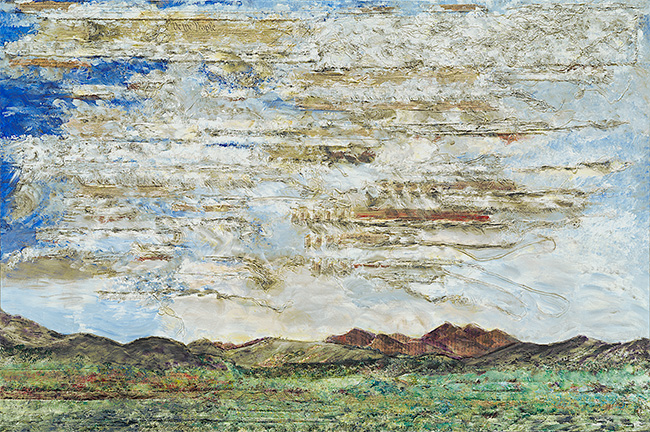
In America Forever (2026), Morris combines the visual power of the American landscape with documents connected to the country’s historical foundation. At 48 by 72 inches, the large composition stretches outward with a strong panoramic quality. A range of mountains runs along the lower edge, while the sky dominates the majority of the painting. Rather than appearing calm or empty, the atmosphere is filled with dense layers of white, blue, gray, gold, and muted brown.
The surface resembles a sky in constant transition. It may suggest shifting clouds, passing storms, eroded stone, or old papers marked by time. Morris allows these associations to exist together, avoiding a single literal interpretation. As the viewer studies the work, recognizable landscape elements move between abstraction and representation.
Historic national documents are integrated into the painting as both source material and symbolic content. Fragments of written language move through the textured surface, sometimes emerging clearly and sometimes becoming covered by paint. The documents are not treated as background references or added illustrations. They are built into the work, just as their ideas were built into the development of the country.
Their incomplete visibility creates a meaningful tension. Some words appear accessible, while others seem buried, weathered, or interrupted. This treatment may suggest how history is preserved and remembered unevenly. Founding principles can remain influential even when their language is overlooked, reinterpreted, or separated from its original context.
Through her sculptural process, Morris gives written history weight and dimension. The documents become objects with texture rather than distant records. Their physical presence emphasizes that a national identity is formed through more than territory. It is also shaped by language, civic ideas, laws, promises, disagreements, and the ways successive generations understand them.
Below this heavily worked atmosphere, the landscape provides a visual anchor. Dark mountain forms rise beside warm red and brown peaks. Across the foreground, green areas are interrupted by many small points of color and varied materials. The land looks fertile and energetic, but not entirely peaceful. It carries the same sense of movement found in the sky.
This contrast creates a dialogue between endurance and transformation. The mountains suggest an ancient stability that exceeds human history, while the active sky reflects uncertainty and change. The landscape may remain, yet the nation associated with it continues to develop through new events, interpretations, and experiences.
The title America Forever initially sounds like a confident declaration. Within the complexity of the painting, however, “forever” becomes less straightforward. Morris does not describe the country as a finished or unchanging idea. America appears to be continually formed by the interaction of place, history, memory, and contemporary life. The work encourages reflection on what a country chooses to preserve and what may become difficult to see over time.
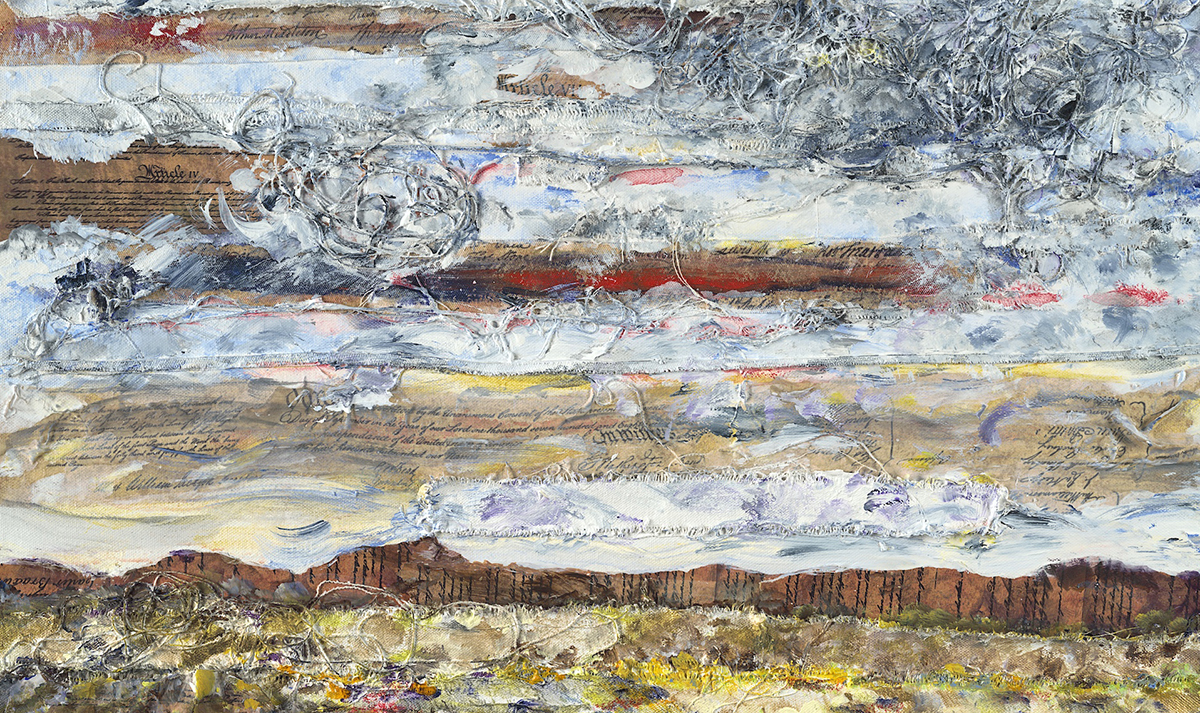
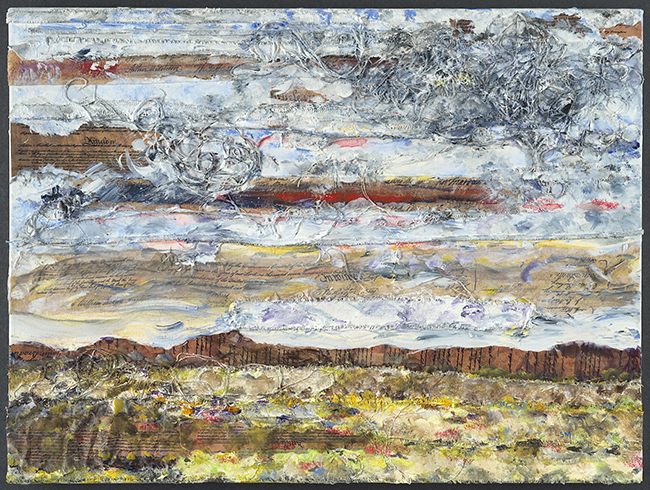
Morris returns to several of these concerns in What A Day (2026), a 20-by-26-inch acrylic and mixed-media work. Although smaller, the painting contains an intense concentration of visual activity. Raised lines, tangled forms, bands of color, written passages, and layered materials compete for attention across its surface. Reds, yellows, blues, grays, and metallic tones appear in quick bursts, giving the composition an unsettled energy.
A line of reddish cliffs stretches horizontally through the lower half of the image. This formation creates a moment of stability between the dense sky and the textured ground. Above it, materials curl, overlap, and gather into cloudlike masses. These forms may recall weather, smoke, wind, or a mind attempting to process many events at once.
The title gives the work a more immediate and personal tone. What A Day sounds like a spontaneous response after an unusually complicated experience. The composition reflects that feeling through its crowded layers and interrupted passages. It seems to hold several impressions simultaneously rather than arrange them into a simple sequence.
Historic writing again appears within the surface, connecting the present moment with a broader inheritance. The words move across the landscape like traces left behind by earlier voices. Their inclusion suggests that no individual day is entirely isolated. Personal experience continues to unfold within histories, systems, and ideas carried forward from the past.
The two works offer different viewing experiences. America Forever creates impact through its broad scale and sweeping horizon, while What A Day concentrates its energy within a smaller, more intimate space. One feels expansive and reflective; the other feels immediate and compressed. Yet both resist quick interpretation.
Through these Sculpted Paintings®, Morris makes history and landscape physically present. Paint, text, texture, and light remain in continuous conversation, changing as the viewer moves. Her works are not static descriptions of America or nature. They are layered encounters that ask to be examined slowly, experienced spatially, and understood through both the eye and the body.
