

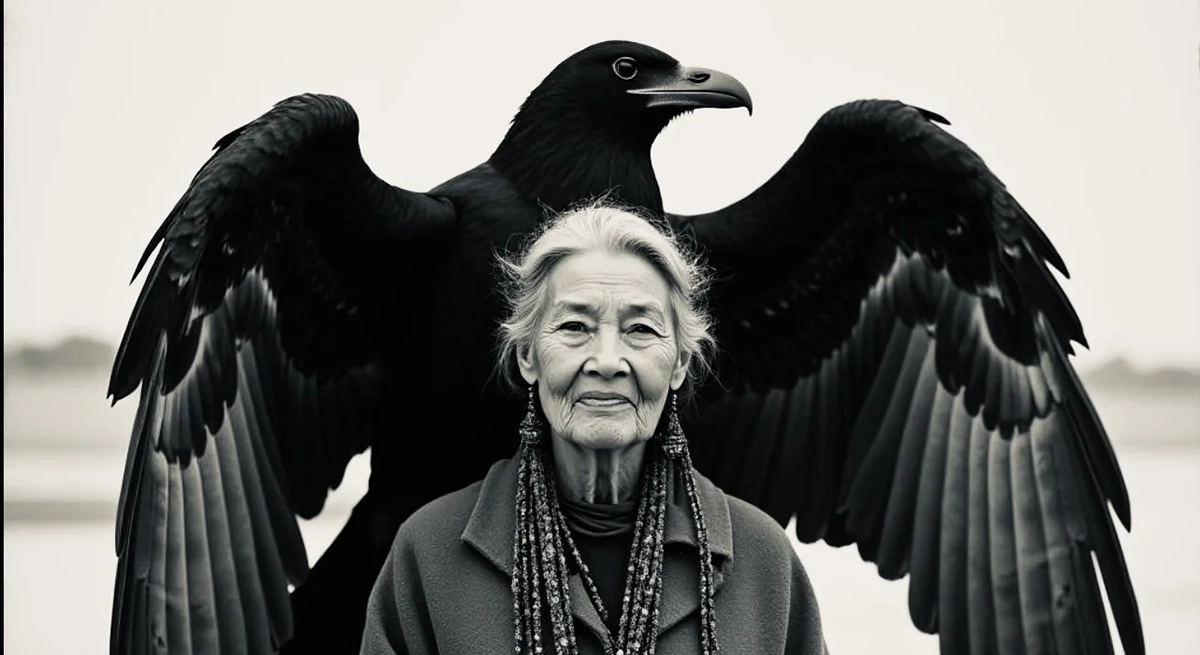
Camille Ross is an American photographer and visual artist whose work reflects a life shaped by contrasting cultures, inherited histories, and an enduring search for belonging. Born in San Francisco in 1964, Ross spent her formative years between the radical atmosphere of 1970s Berkeley and rural Mississippi. Moving between these remarkably different environments gave her an early awareness of cultural divisions, social identity, and the many ways history influences personal experience.
Ross’s biracial heritage and Cherokee ancestry have become central to her artistic perspective. Her images frequently explore migration, memory, spirituality, and the invisible bonds connecting one generation to another. Rather than treating ancestry as something confined to the past, she presents it as a living presence that continues to appear through dreams, symbols, and intuition. Photography and emerging digital tools allow Ross to transform these deeply personal experiences into layered visual narratives about survival, guidance, and the long journey home.
Tracing the Footsteps of Ancestry
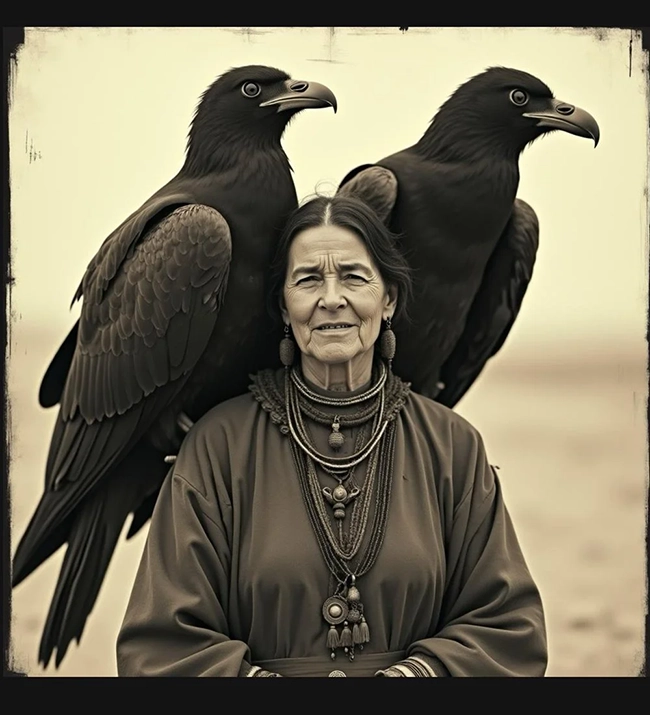
In this series, Ross constructs a symbolic tribute to her ancestors and the journeys they undertook across generations. The work follows a vast geographical and emotional passage, beginning in Mongolia and continuing through the Siberian Strait, Alaska, the Great Plains, Oklahoma, and the Cherokee Nation. Each location represents more than a point on a map. Together, they form an ancestral road marked by movement, upheaval, adaptation, and endurance.
Ross understands her family history as part of a much larger story of migration. She describes ancestors who traveled from Siberia to Alaska and became members of a small coastal fishing tribe. Within this community, ravens were respected for their intelligence and their symbolic ability to guide, heal, and help people find their way home. These qualities give the raven a powerful presence throughout Ross’s work. It appears not simply as an animal, but as a messenger moving between memory, landscape, and the spiritual world.
Her exploration later reaches the Plains, where Ross says she located a relative connected to the Lakota Sioux Reservation who fought in the Battle of Wounded Knee. The ancestral path then continues to Oklahoma, historically described as “Indian Country,” and eventually to the Cherokee Nation. Within this history is the painful story of Ross’s great-grandmother and her siblings, whom Ross identifies as Cherokee slaves, as were their parents.
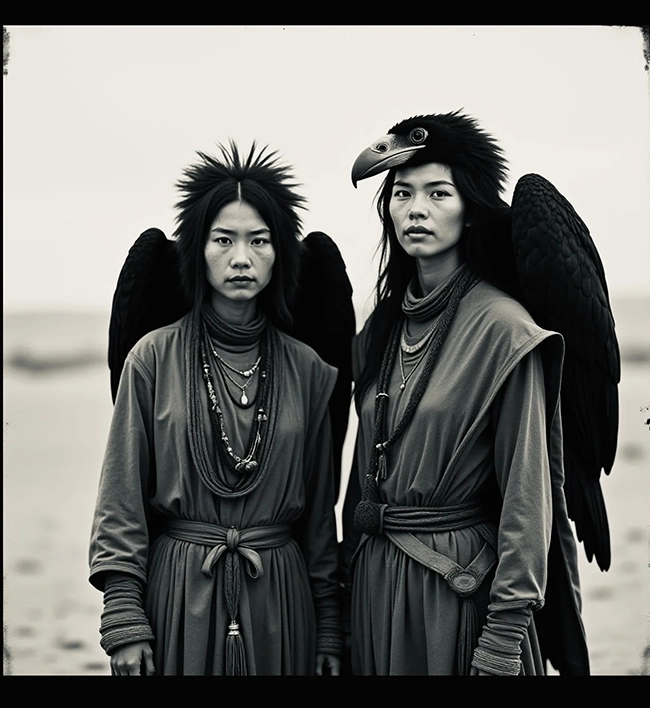
Her great-grandmother later had two daughters, Ojanna and Oleta. Ojanna, Ross’s grandmother, was a Cherokee woman born in the early twentieth century who died before Ross had the opportunity to meet her. Art therefore becomes a way of approaching someone known through lineage rather than lived memory. Through image-making, Ross creates a space in which separation between generations can be reconsidered and, symbolically, crossed.
Ravens, Eagles, and the Language of Dreams
Ravens and eagles repeatedly enter Ross’s visual world because they hold both cultural and personal significance. Yet their presence is not based solely on research or inherited symbolism. Many of these images originate in dreams.
Ross explains that much of her recent work emerged from one particularly profound dream about her ancestors. In it, she was walking along a long red road leading away from the city when an enormous red-tailed hawk landed on her shoulder. The bird appeared magnificent and protective. It eventually transformed into a striking Native American chief.
This transformation became an important source for the hybrid spiritual figures that populate her work. Ross compares the experience to traditions in Hinduism in which gods and deities may appear with both human and animal characteristics. In her own imagery, birds perch on the shoulders of female shamanic figures, falconers, and healers. These presences suggest guardianship and a form of knowledge that cannot be reached through ordinary observation alone.
The red road may be interpreted as a passage away from modern distraction and toward ancestral recognition. The hawk’s arrival transforms that journey into an encounter with protection, beauty, and inherited strength. Ross has long felt that her ancestors watch over her; the dream gave that conviction a vivid form she could carry into her art.
Giving Form to the Previously Unseen
Although Ross is rooted in photography, recent technological developments have expanded how she can articulate these visions. She uses artificial intelligence as a creative instrument, enabling her to construct scenes that would be difficult to produce through conventional photography alone. For Ross, the technology does not replace the emotional or conceptual origin of the artwork. That origin remains her family history, her imagination, and her dreams.
AI instead provides a method for translating internal visions into visible form. The resulting works occupy a space between photography, digital composition, mythology, and symbolic portraiture. They do not function as literal historical documents. Rather, they are personal meditations on histories that have been fragmented, partially lost, or transmitted through family memory.
Ross’s series ultimately asks what it means to inherit a journey one did not personally witness. Her answer is built through ravens, eagles, healers, dream figures, and roads extending beyond the frame. These images honor lives shaped by migration and survival while recognizing that ancestry is never entirely fixed in the past.
Through her work, Ross creates a visual meeting place for family history and contemporary technology. The tools may be new, but the human desire behind them is ancient: to remember where one came from, to recognize those who traveled before, and to find a path home.
