

For Allan Wesaquate, painting is a way of exploring emotion rather than preserving a single moment in time. His abstract works develop through movement, intuition, and the physical behavior of paint. Using acrylics and expressive forms of mark-making, he constructs layered surfaces in which colors appear to flow, collide, dissolve, and reappear. Although personal experiences may provide the initial impulse for a painting, Wesaquate does not limit the finished work to one story or interpretation. Instead, he creates an open visual space where viewers can form their own emotional connections. His bold colors, fluid gestures, and richly worked textures give the paintings a sense of continuous activity. Shapes seem to change as the eye moves across them, allowing each composition to feel different with every encounter. Through this approach, Wesaquate presents abstraction as a living exchange between feeling, material, imagination, and the individual viewer.
Surfaces of Energy, Texture, and Transformation
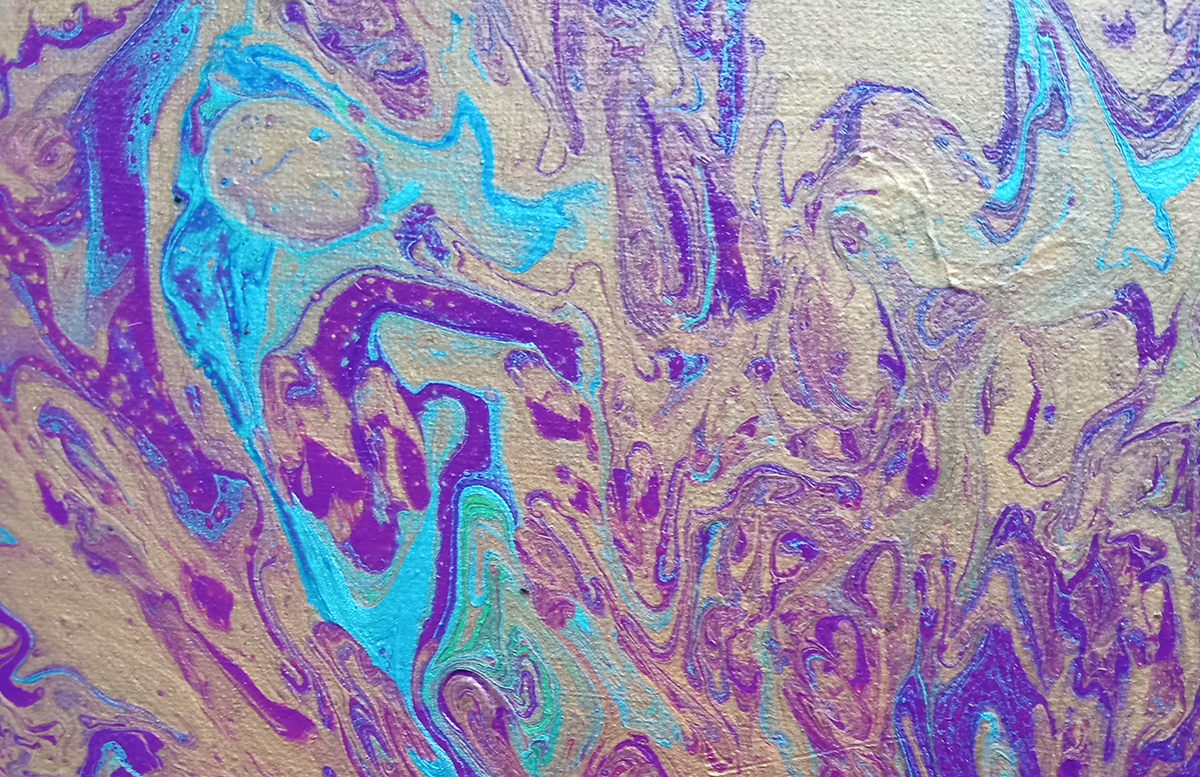
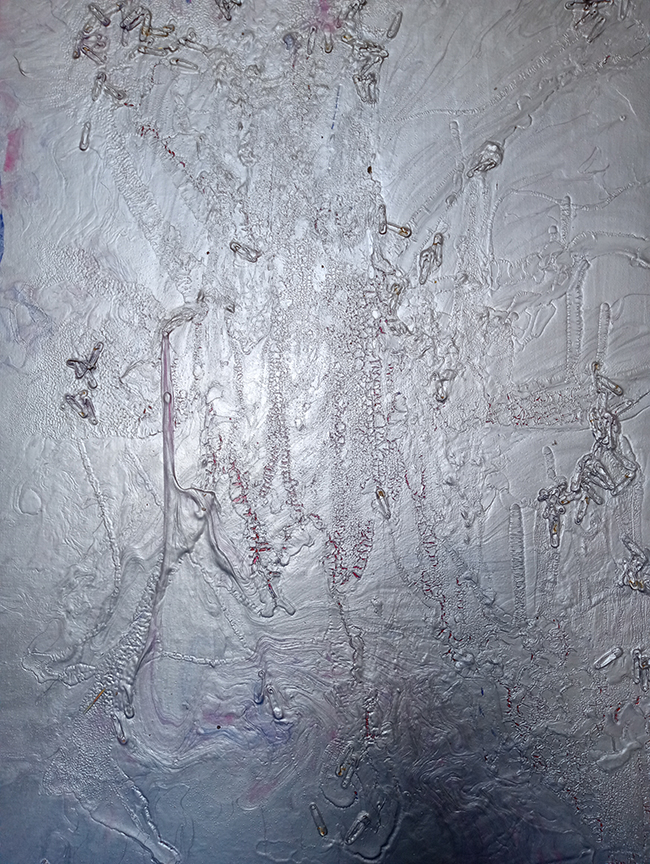
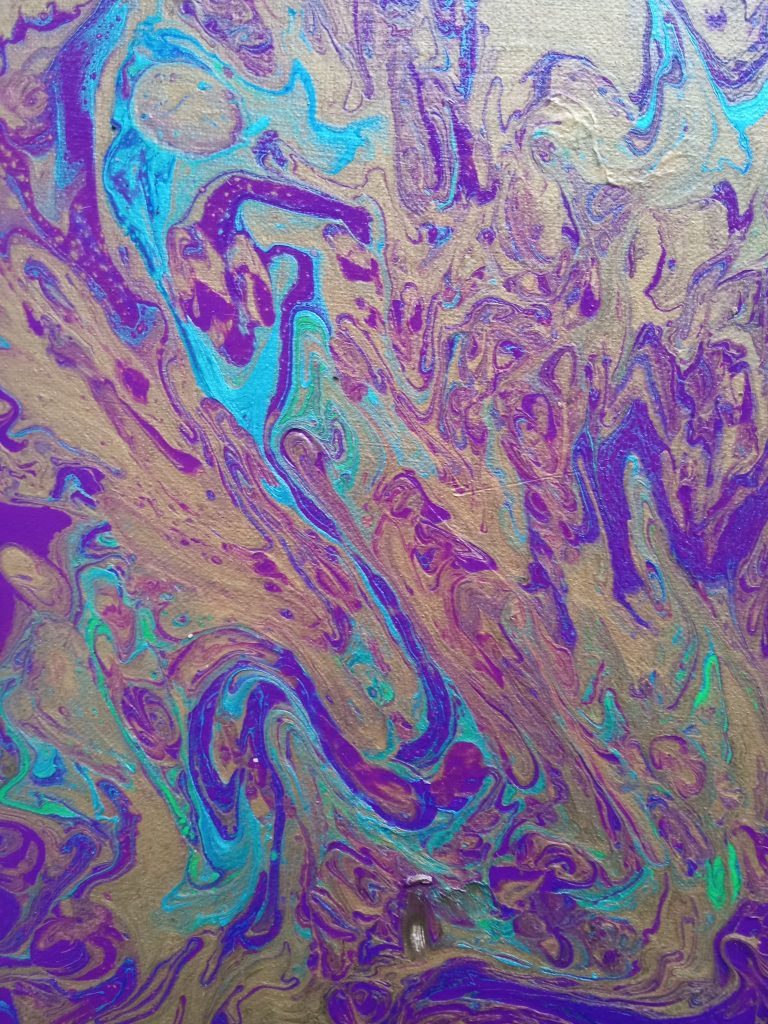
The artworks shown here reveal two different yet connected aspects of Wesaquate’s abstract practice. One is pale, restrained, and almost monochromatic, while the other is saturated with turquoise, violet, green, and metallic earth tones. Despite their contrasting palettes, both paintings are united by an interest in layered movement. Neither composition offers a central object to identify. Instead, the entire surface becomes active, encouraging the viewer to travel through its textures, lines, and shifting areas of color.
In the lighter painting, silvery white and cool gray tones cover the surface like frost, weathered stone, or an aerial view of an unfamiliar landscape. The restrained color creates an atmosphere of quietness, but the work is far from empty. Its surface contains an intricate network of ridges, trails, raised marks, scratches, and translucent forms. Some passages resemble flowing water, while others suggest mineral deposits, delicate roots, or impressions preserved beneath ice.
A darker concentration toward the bottom gives the painting a subtle sense of depth. It appears as though the viewer is looking into a space that gradually becomes denser and less certain. Small touches of red, blue, violet, and gold interrupt the pale field. Because these colors are used sparingly, they carry unusual visual weight. They appear like fragments of memory or brief signals emerging from within the layered material.
The painting’s physical surface is especially important. Wesaquate allows acrylic paint to become more than color; it behaves almost like a sculptural substance. Drips harden into raised lines, while thicker sections form irregular patterns that catch the light. These details invite close observation. From a distance, the work feels atmospheric and expansive. Viewed closely, it becomes an intimate environment filled with countless marks and subtle events.
The second painting produces a more immediate burst of energy. Turquoise, purple, green, and deep blue twist through a warm, metallic-looking background. The colors do not remain in clearly separated areas. They fold into one another, creating loops, currents, and elongated forms that seem to be continually transforming. The effect recalls water carrying streams of pigment, molten material moving under pressure, or an imagined ecosystem expanding across the surface.
Its forms can also prompt shifting associations. A viewer might briefly recognize faces, plants, animals, waves, or microscopic organisms, only to see those suggestions disappear into the surrounding pattern. This uncertainty is central to the painting’s appeal. Wesaquate gives the imagination enough visual information to begin forming connections but leaves the composition open before those connections become fixed.
There is a strong sense of rhythm throughout the work. Curving lines move upward, downward, and diagonally, while smaller swirls create moments of interruption. Dense passages sit beside calmer areas, producing a visual tempo that alternates between intensity and release. The viewer’s eye is never directed along only one path. It can enter the painting from almost any point and discover a different journey through its layered colors.
Together, these works demonstrate the range that can exist within Wesaquate’s approach to abstraction. One painting communicates through restraint, subtle variation, and a nearly silent atmosphere. The other speaks through chromatic intensity and vigorous motion. Yet both depend on the interaction between intention and unpredictability. The artist guides the materials, but he also allows their natural movement to influence the final result.
Wesaquate’s paintings do not demand to be decoded. Their meaning develops through the experience of looking: noticing a texture, following a line, sensing a change in mood, or discovering an unexpected form. This openness gives the work its vitality. Each viewer brings different memories and emotions to the surface, making every encounter personal. In Wesaquate’s art, abstraction is not an escape from experience. It is a flexible language through which experience can remain active, unresolved, and continually renewed.
