

Anna Mazzotta follows an independent creative direction, developing her work through observation, instinct, and imagination rather than contemporary trends. Born in the United Kingdom and influenced by her Italian heritage, she divides her time between London and Bristol. The culture and contrasting rhythms of these cities inform an artistic practice concerned with identity, performance, memory, and the complexities of human behaviour.
Mazzotta studied at the Royal College of Art, where she developed the technical skills that support her distinctive approach to drawing. Her work, however, is not limited to accurate representation. She reshapes familiar people and events through her own theatrical perspective, building layered scenes in which every figure, gesture, and expression has a role.
Her compositions frequently feel like moments taken from a play. Curtains frame the action, crowds become a chorus of emotional reactions, and central figures appear as performers facing both one another and the audience. Humour and exaggeration are often present, but beneath these qualities lies a serious interest in pressure, ambition, vulnerability, and public identity.
Charcoal and chalk give Mazzotta the freedom to work with both force and delicacy. Heavy areas of charcoal establish depth and intensity, while finer marks capture faces, clothing, movement, and architectural detail. Chalk brings light into the darker passages. Carefully chosen areas of red or orange introduce visual rhythm and direct attention toward the emotional centre of each scene.
“I’m So Mean, I Make Medicine Sick”
Charcoal and chalk on paper
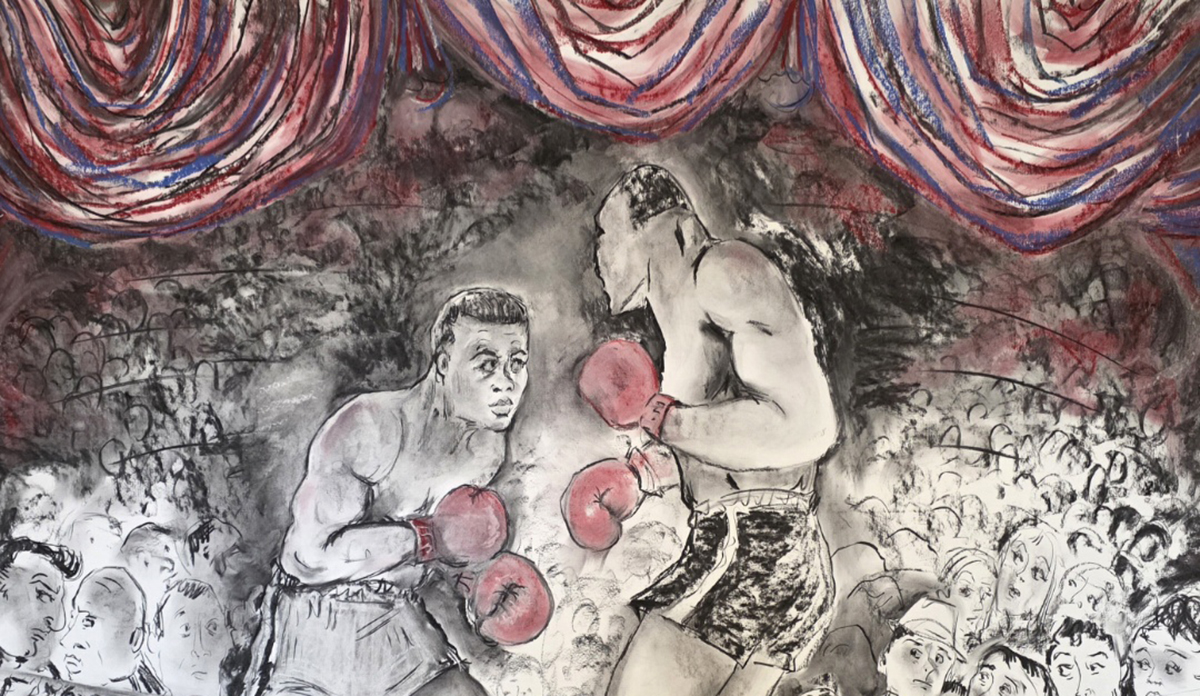
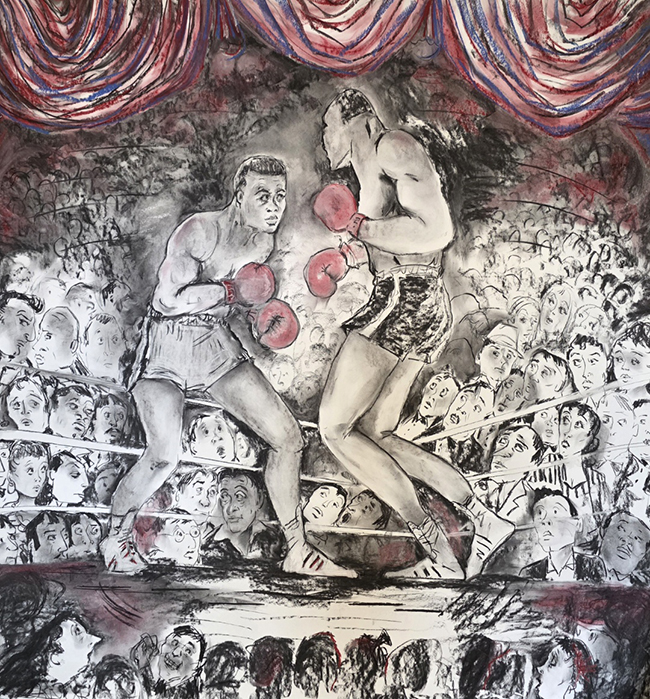
In I’m So Mean, I Make Medicine Sick, Mazzotta depicts Muhammad Ali in the charged setting of the boxing ring. The title refers to a statement Ali made before his 1974 fight with George Foreman. Rather than allowing the quotation to dominate the work, Mazzotta uses it to support a wider exploration of personality, self-presentation, and the experience of performing under intense public attention.
The composition is built around the physical encounter between the two fighters. Ali and his opponent stand in the centre, surrounded by rows of spectators whose faces cover much of the image. Some watch with concentration, while others appear surprised, anxious, or fascinated. Mazzotta gives these individuals their own expressions and personalities, making the crowd an essential part of the scene rather than a decorative background.
Above the ring, red, white, and blue fabric falls in broad theatrical folds. This framing turns the arena into something resembling a stage. The fighters become performers whose actions are observed, judged, and remembered by others. Through this construction, Mazzotta connects athletic competition with theatre, where physical presence, timing, and control are as important as the final outcome.
The red gloves stand out against the mainly monochrome surface, emphasizing the immediate threat of physical contact. Around them, shifting areas of charcoal and chalk create movement and visual noise. Mazzotta balances carefully rendered figures with looser marks, capturing both the structure of the event and its unpredictable energy.
Ali’s familiar confidence is present, but the drawing is primarily concerned with how Mazzotta interprets the complete scene. She examines the way a public figure is shaped by spectators, setting, gesture, and expectation. The result is a study of performance that extends beyond the identity of the boxer himself.
“Why Waltz with a Guy for 10 Rounds If You Can Knock Him Out in One?”
Charcoal and chalk on paper
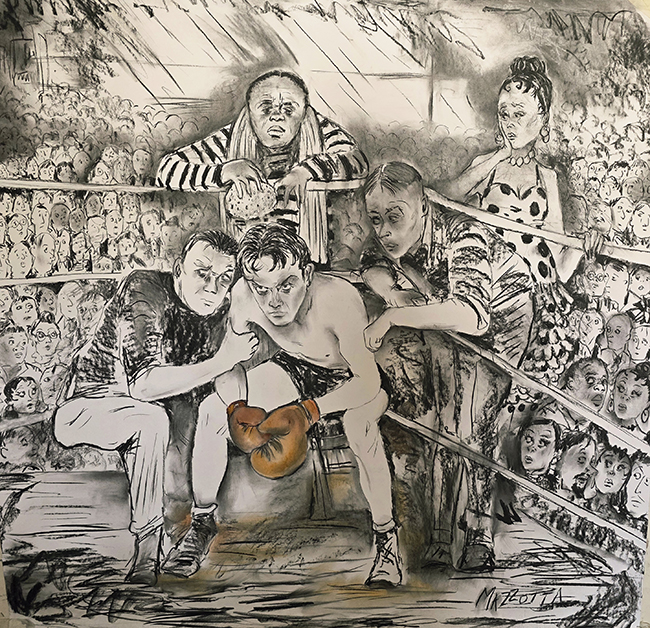
In Why Waltz with a Guy for 10 Rounds If You Can Knock Him Out in One?, Mazzotta turns her attention away from direct combat and toward the interval between rounds. Rocky Marciano sits in his corner with members of his team gathered closely around him. The scene reveals a less public side of boxing, defined by fatigue, concentration, care, and preparation.
Marciano’s seated figure anchors the composition. The people beside and behind him lean inward, creating a strong sense of enclosure. Their serious expressions and attentive gestures suggest the importance of this brief pause. Mazzotta presents strength not as an isolated personal quality, but as something supported by trust, discipline, and the assistance of others.
Beyond this close group, faces continue across the arena. The tightly packed audience produces a sense of scrutiny and expectation. Although Marciano is temporarily removed from the action, he cannot escape the presence of those watching him. Rest becomes another part of the spectacle.
The boxer’s orange-brown gloves provide the principal colour within the image. Positioned at the centre, they appear heavy and temporarily inactive. This stillness creates tension because the viewer understands that it will soon end. Mazzotta captures the psychological space between exhaustion and renewed action.
Together, these works demonstrate how Mazzotta transforms boxing into a study of broader human experience. She is interested not only in the fighters but also in the people surrounding them, the emotions passing through the crowd, and the contrast between public confidence and private vulnerability.
Through detailed observation, dramatic composition, and expressive materials, Mazzotta creates scenes that are both recognizable and deeply personal. The boxing ring becomes a setting in which she can examine courage, pressure, dependence, and the difficult performance of appearing strong.
