

Jo Gabe uses painting as a way to hold onto experience while allowing it to change over time. Working across acrylic, oil, and pastel, the practice moves between observation and feeling, where memory remains fluid and place is never entirely fixed. While there are hints of artists like Kandinsky in the looseness of form and sensitivity to color, Gabe’s work stays grounded in personal reflection rather than pure abstraction. Landscapes, interiors, and figures are not treated as separate subjects. Instead, they extend from lived moments, connected through mood and recollection.
Travel continues to inform this approach. From the layered intensity of Sydney to the openness of Queensland, Gabe gathers impressions that later return in altered forms. These are not direct translations of what was seen. They move through memory, becoming softened, simplified, or reshaped until they carry a more internal presence. The work that emerges feels less like documentation and more like a reworking of experience, where meaning develops through atmosphere, gesture, and tone.
The Work
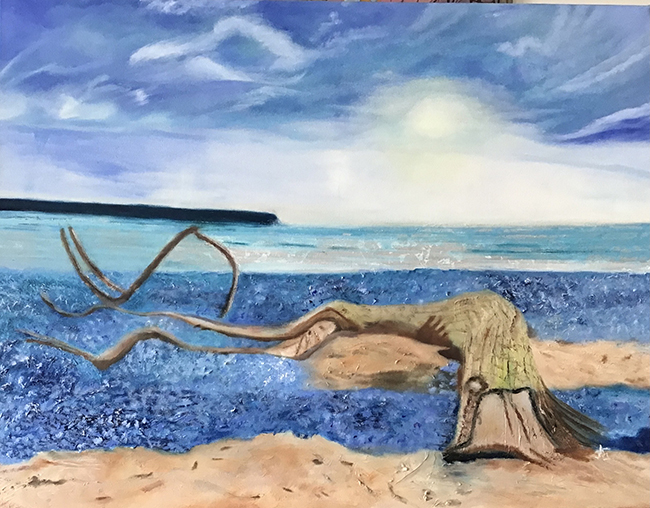
Gabe’s paintings exist in a space where representation begins to loosen, allowing image and emotion to merge. This becomes evident in the two works presented, Noosa North Shore and The Voyeur. While one moves through landscape and the other through portraiture, both are guided by the same intention—to move beyond surface description and into something more reflective and psychological.
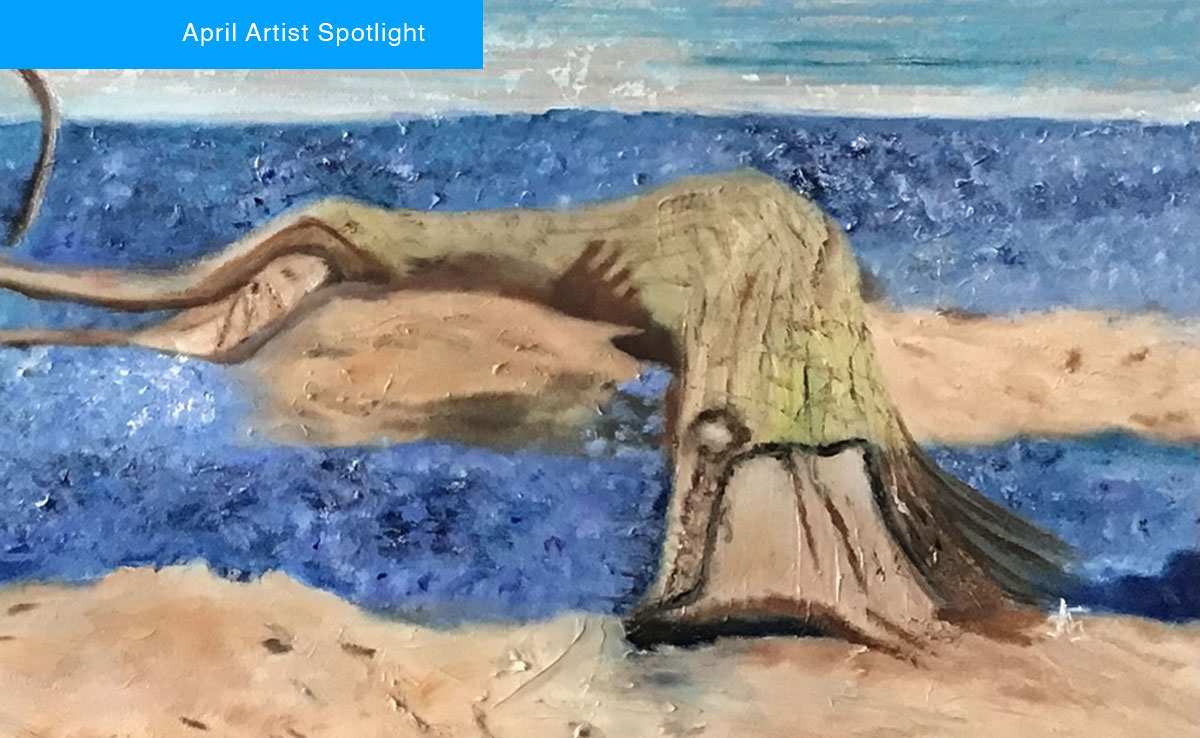
In Noosa North Shore, the coastline is initially familiar, but that sense of clarity quickly shifts. The horizon provides structure, yet the surrounding elements feel unsettled. The ocean is built through layered blues, giving it both density and movement. The surface carries a tactile quality, as if the paint itself echoes the rhythm of the tide.
The addition of silverleaf alters how light behaves across the canvas. Rather than remaining constant, it shifts depending on the viewer’s position, creating a surface that feels unstable. This instability mirrors the way memory functions, where images change over time and clarity becomes inconsistent.
A fallen tree stretches across the center of the composition, reaching from the sand into the water. Its elongated form guides the eye across the painting, acting as both a physical object and a subtle symbol. It suggests interruption, transition, or the quiet trace of something that has already occurred. Though there are no figures present, the space does not feel empty. Instead, it holds a quiet sense of presence, as if something lingers just outside view.
The sky above remains soft and diffused, contrasting with the heavier textures below. The light feels distant, creating a sense of pause within the scene. Time appears to slow, giving the painting a suspended quality.
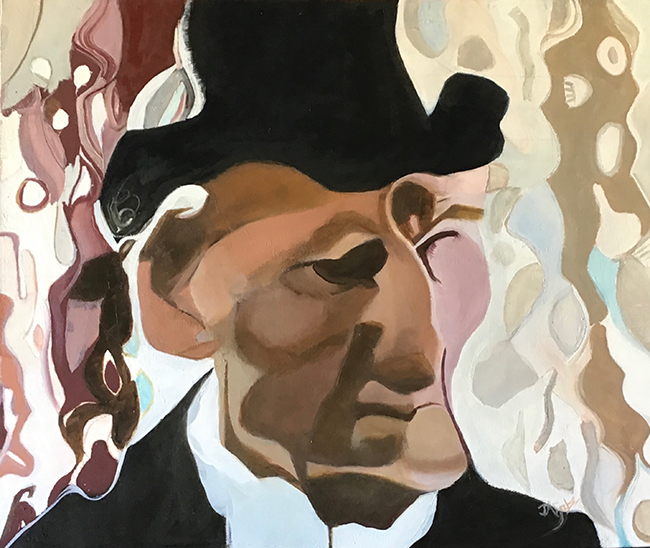
In The Voyeur, Gabe shifts focus inward. The figure appears in profile, yet the features resist clear definition. Edges soften and tones blend, making the face difficult to fully resolve. The subject remains partially obscured, placing the viewer in a position of looking without complete understanding.
The title suggests observation, but the painting complicates that idea. It is unclear who is watching and who is being watched. The obscured eye limits direct connection, introducing a subtle distance. This distance creates tension that runs quietly through the work.
Color plays a central role in constructing the figure. Flesh tones are layered with muted pinks, browns, and cooler hues, creating a surface that feels in flux. The background is filled with abstract forms that suggest figures without fully forming them. These shapes linger as fragments, reinforcing the sense that the image exists somewhere between perception and imagination.
The handling of paint remains controlled yet flexible. Edges dissolve, transitions stay soft, and forms appear and recede at the same time. The painting feels open, as if it is still in the process of forming. This lack of resolution is intentional and becomes part of its structure.
Across both works, Gabe resists presenting a fixed image. Landscape and figure are approached in the same way—through suggestion rather than definition. Forms shift, light behaves unpredictably, and space expands or compresses through memory.
There is a quiet restraint in this approach. The paintings do not rely on scale or intensity to command attention. Instead, they draw the viewer in through subtle shifts—through light that moves, through forms that never fully settle. The work remains open, allowing meaning to unfold gradually rather than presenting it all at once.
