

Huang YI Min’s life and work are closely bound to the layered history and cultural fabric of China. Born in 1950, she grew up during a period of rapid and often difficult transformation, experiences that quietly shaped the direction of her artistic thinking. After completing her studies in Fine Arts at Beijing Normal University, she carried this background with her when she moved to the United States in 1997. The shift in geography did not distance her from her origins; instead, it sharpened her perspective. Her work reflects a personal dialogue between memory and place, where lived experience, cultural history, and observation merge into visual narratives that feel both intimate and expansive.
The Artist’s Work
Huang YI Min’s Forbidden City Freedom series moves between observation and imagination, constructing scenes that feel at once grounded and dreamlike. The two works presented here—The Moon Outside the Palace Museum Wall (80 x 86 cm, mixed media on paper) and Windless Day (82 x 90 cm, mixed media on paper)—offer a layered view into a world that exists between past and present, permanence and disappearance.
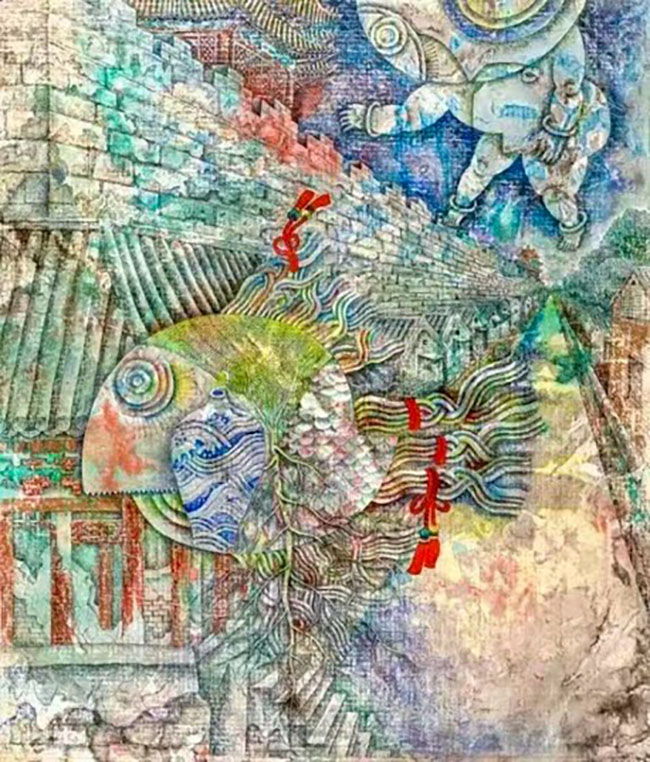
In The Moon Outside the Palace Museum Wall, the composition unfolds like a memory that refuses to stay fixed. The surface is filled with architectural fragments—walls, tiled roofs, and the recognizable structure of the Forbidden City—yet these elements are not static. They dissolve into textures, colors, and unexpected forms. A large, stylized fish floats through the scene, its body composed of intricate patterns, shifting tones, and rhythmic lines. The fish does not belong to the physical space in any literal sense, yet it feels entirely at home. It becomes a carrier of movement, perhaps even a symbol of freedom, gliding across boundaries that the built environment tries to impose.
Hints of daily life appear subtly: traces of habitation, fragments of structures, and the suggestion of human presence. The setting recalls an evening atmosphere, where the fading light softens the edges of reality. This aligns with the artist’s written imagery—lovers by the river, swallows returning home, and the walls of the Forbidden City turning poetic under the glow of dusk. These references are not illustrated directly but are embedded in the tone of the work. The piece becomes less about a specific moment and more about the feeling of time passing through a place.
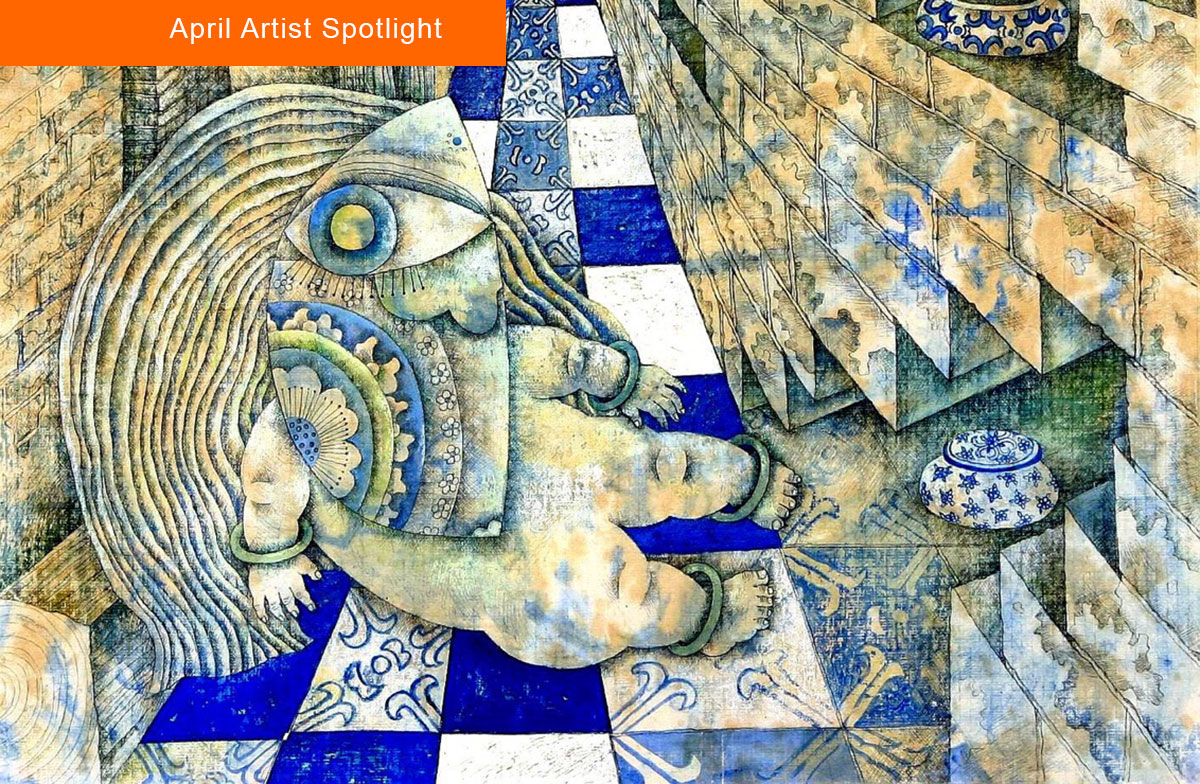
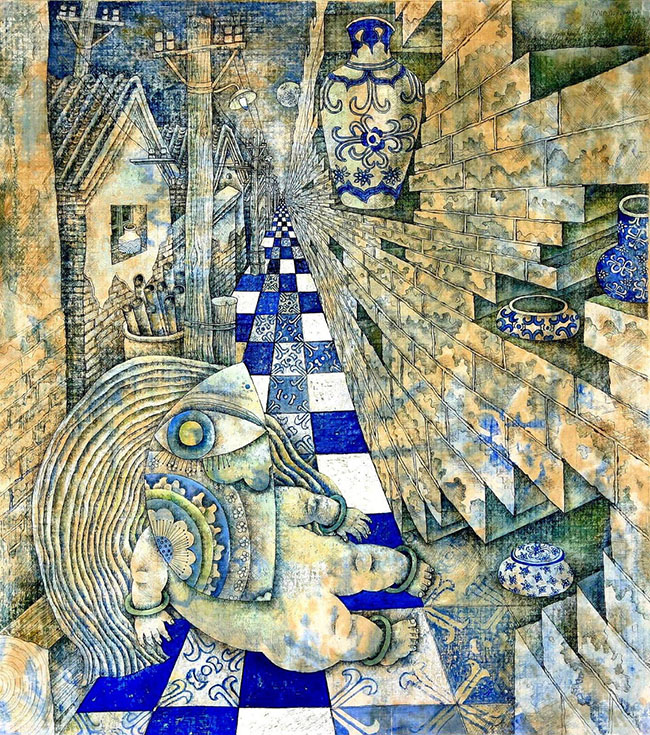
In contrast, Windless Day carries a quieter, more introspective mood. The composition draws the viewer into a narrow alley space, structured by receding perspective and a patterned floor that pulls the eye inward. Blue-and-white ceramic motifs appear throughout the scene—vases, tiles, and decorative elements—creating a visual rhythm that echoes traditional Chinese design. These forms are precise yet slightly distorted, giving the impression that the space is shifting or bending under the weight of memory.
A reclining, human-like figure occupies the foreground, its form merging with decorative patterns and architectural lines. Like the fish in the previous work, this figure resists a single interpretation. It appears both grounded and suspended, as if caught between movement and stillness. The surrounding environment—brick walls, household objects, and narrow passageways—suggests the everyday life of hutong neighborhoods. Yet the stillness implied by the title, Windless Day, transforms this space into something more contemplative. There is no visible motion, only the quiet accumulation of time.
The narrative behind these works deepens their resonance. Huang reflects on the lived reality of the Forbidden City hutongs—spaces where historical architecture and daily life once coexisted. Her description of midnight scenes reveals details that are often overlooked: improvised kitchens, shared utilities, worn brickwork, and the subtle marks of human presence. These elements speak to a kind of lived history that exists beyond official narratives. They are not grand or monumental, but they carry weight through repetition and use.
The eventual demolition of these spaces becomes a central emotional thread. What once held layers of life—stories embedded in walls, objects shaped by routine—was reduced to debris. The transformation was abrupt and indifferent, as suggested by the image of bulldozers moving through without awareness of what was being erased. This contrast between memory and erasure is not depicted in a literal sense but is felt throughout the works. The fragmented compositions, shifting perspectives, and blending of forms all echo this sense of loss.
Yet Huang does not approach this subject with overt sentimentality. Instead, she allows the visual language to carry the weight. The mixing of reality and imagination becomes a way to preserve what can no longer be physically accessed. By reassembling fragments—architectural, cultural, and emotional—she creates a space where memory continues to exist, even as the original environment has disappeared.
The title Forbidden City Freedom suggests a quiet tension. The Forbidden City, historically associated with restriction and control, is reimagined as a space where forms can move freely—fish can float through walls, figures can rest within shifting environments, and time itself becomes fluid. This freedom is not about escape but about reinterpretation. It is a way of reclaiming space through memory and imagination.
In these works, Huang YI Min offers more than a depiction of place. She constructs a visual reflection on how environments are lived in, remembered, and ultimately transformed. The result is a body of work that feels both personal and expansive, grounded in specific experiences yet open to broader interpretation.
